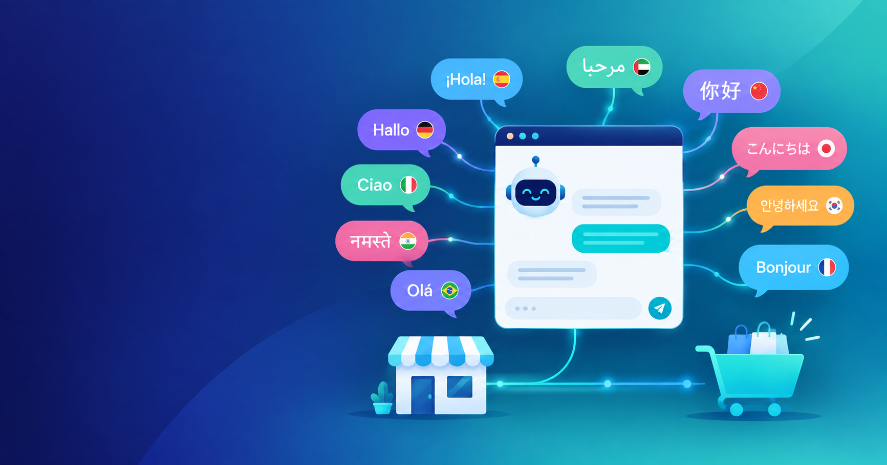
Your Shopify store might be well designed, fairly priced, and fully stocked. But if a shopper lands on it, asks a question in Hindi, Spanish, or Arabic, and your chat only answers in English, most of them will simply leave.
A multilingual AI sales agent for Shopify solves this. It greets shoppers, answers product questions, recommends items, and guides them to checkout in the language they actually think in, without you hiring a separate support team for every market.
In this guide you will learn:
- Why language is one of the most overlooked conversion barriers in ecommerce
- The difference between a translated chatbot and a native multilingual AI agent
- How popular AI chatbots handle multiple languages (with a comparison table)
- How to test, choose, and set up a multilingual AI sales agent on your store
- What Indian stores need to know about Hindi, Gujarati, and Hinglish
TL;DR
- CSA Research found that 76% of online shoppers prefer to buy from sites with information in their own language, and 40% will not buy from sites in other languages at all.
- Many "multilingual" chatbots are English bots wrapped in a translation layer. This leads to stiff replies, wrong product answers, and lost trust.
- A good multilingual AI sales agent detects the shopper's language, understands intent, answers from your catalog, recommends products, and hands over to a human when needed, all in the same language.
- Do not choose a tool by its language count. Test it with real questions in your target languages.
Why Language Is a Hidden Conversion Barrier
Most stores track bounce rate, cart abandonment, and ad spend down to the decimal. Very few track how many visitors left because they could not get help in their own language. That loss never shows up as a line item.
The research points to a real problem:
- 76% of online shoppers prefer to buy products with information in their native language, and 40% will never buy from websites in other languages (CSA Research).
- 65% of consumers prefer content in their own language even when they are fluent in English (CSA Research, cited by multiple vendors).
- 75% are more likely to buy again when customer support is in their language (CSA Research).
These figures come from CSA Research studies published between 2020 and 2022, so treat them as directional rather than a 2026 measurement.
The takeaway is simple. Language support is not only for global brands. It affects first purchases, repeat purchases, and how much trust a shopper places in your store. This matters even more in multilingual regions such as India, where one shopper may write in English, Hindi, and Gujarati in the same conversation.
What Is a Multilingual AI Sales Agent?
A multilingual AI sales agent is an AI assistant that lives on your store (and often on WhatsApp, Instagram, and Messenger) and does the job of a good shop assistant in more than one language.
It typically handles:
- Product discovery:"Show me a moisturizer for dry skin under ₹800."
- Recommendations:suggesting the right product based on the conversation
- Upsell and cross-sell:offering matching items at the right moment
- Support:shipping, returns, sizing, and order status
- Lead capture:collecting name, email, and phone number
- Handover:passing complex cases to a human with the full conversation
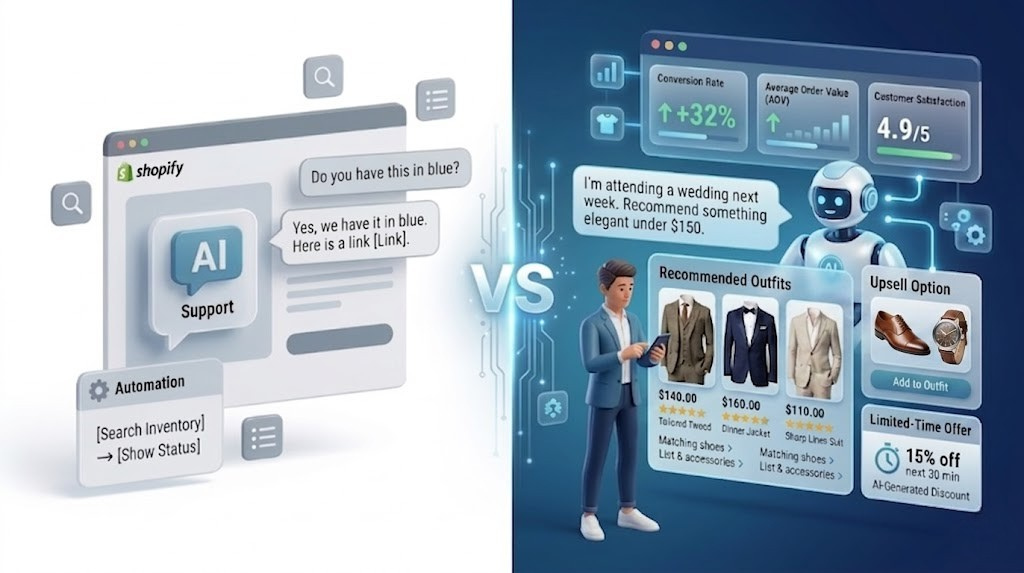
To see how this differs from a basic chatbot, read our guide on Shopify AI chatbot vs AI sales agent.
Translated Chatbot vs Native Multilingual AI Agent
This is the most important distinction, and where many stores get burned.
Some chatbot apps claim multilingual support but work like this: the shopper's message is translated into English, the AI replies in English, and the reply is translated back. On paper it sounds fine. In practice it often breaks down.
| Translated chatbot | Native multilingual AI agent | |
|---|---|---|
| How it works | Translate in, answer in English, translate out | Understands and replies directly in the shopper's language |
| Tone and idioms | Often stiff or literal | More natural and context-aware |
| Product terms | Can mistranslate brand names, sizes, and materials | Better at keeping catalog terms intact |
| Mixed language (for example Hinglish) | Frequently confused | Handles code-switching more reliably |
| Accuracy risk | Errors can compound at each translation step | Fewer steps, fewer places to go wrong |
| Best for | Simple FAQs | Product discovery, recommendations, and sales conversations |
For stores that sell on trust, such as skincare, jewellery, food, and electronics, a wrong answer in a shopper's own language can cost more than no answer at all.
How a Multilingual AI Sales Agent Works
You do not need to be technical to understand the flow. In a good setup:
- Language detection. The agent reads the shopper's first message and identifies the language, so nobody has to pick from a dropdown.
- Intent understanding. It works out what the shopper wants:a product, a size, an order update, or a discount.
- Answering from your data. It pulls answers from your product catalog, FAQs, and policies. This grounding step is what prevents made-up answers.
- Replying in the shopper's language. The response, including product suggestions, comes back in the same language.
- Escalation. If the question is beyond the AI, it hands over to a human with the conversation history intact.
A useful trick: ask a question in one language when your store content is in another. A well-built agent should still answer correctly. This checks cross-language accuracy far better than a language count does.
Where a Multilingual AI Sales Agent Makes Money on Shopify
Language support is not only a support feature. It touches revenue at several points in the shopping journey.
1. Product discovery
Shoppers with hundreds of products to browse often do not know what to search for. An agent that understands "gift for my mother, something traditional, under 2000" in their own language cuts through that. See our AI product recommendations guide for Shopify.
2. Cart and checkout confidence
The cart page is a high-intent moment. A shopper with a delivery or returns question who cannot get an answer in their language may just close the tab. Learn more in our post on AI cross-sell recommendations on the Shopify cart page.
3. Order tracking and post-purchase support
"Where is my order?" is one of the most common questions in ecommerce. Answering it instantly, in the customer's language, reduces support tickets and builds repeat business.
4. Messaging channels
Many shoppers prefer WhatsApp, Instagram, or Messenger to a website chat box. A multilingual agent that works across channels meets them where they already are. Read why every business needs Meta channel integration and our abandoned cart recovery blueprint.
5. Sales and support in one agent
Running separate tools for pre-sale and post-sale questions creates gaps, and adding languages multiplies them. See why combining sales and support in one AI agent works better.
Selling in India: Hindi, Gujarati, and Hinglish
If your store serves Indian customers, "multilingual" means something specific.
- Regional languages matter. Many shoppers outside the big metros are more comfortable in Hindi, Gujarati, Marathi, Tamil, Telugu, Bengali, or Kannada than in English.
- Code-switching is normal. A message like "mujhe ye size mein available hai kya?" mixes Hindi words in Roman script with English. Tools that detect only one language per message often struggle here.
- WhatsApp is the main channel. For many D2C brands, a large share of conversations happens on WhatsApp, so language support there matters as much as on your website.
- WhatsApp templates need planning. Proactive messages such as order updates and cart reminders generally need pre-approved templates submitted separately for each language.
Tip: Do not test only in perfect Hindi. Test the way real customers write: Roman-script Hindi, spelling mistakes, short phrases, and English product names inside regional-language sentences.
How Popular AI Chatbots Handle Multiple Languages
It pays to compare before you commit. The table below shows how well-known tools position their multilingual capability. Language counts are the vendors' own claims, as reported on third-party comparison pages, so verify current details on each vendor's website.
| Tool | Languages (as claimed) | Multilingual angle | Best fit | What to check |
|---|---|---|---|---|
| Tidio (Lyro AI) | Around 48 | Broad language claim with live chat handoff | Small to mid-size stores wanting chat and AI in one app | One third-party comparison reports that the chat widget's own interface supports far fewer languages than the AI replies. Test the whole widget. |
| Intercom (Fin) | Around 45 | Strong for knowledge-base support; can fall back to real-time translation when content is missing in the shopper's language | Larger support teams already on Intercom | Retrieval-first support focus; check its product discovery and selling depth |
| Freshchat | 50+ | Language list includes Hindi and Gujarati; supports mixed languages such as Hinglish | Teams already on the Freshworks suite | Multilingual flows may need technical setup |
| SiteGPT | 95+ | Automatic content sync from your sources | Stores wanting a no-code support bot with many languages | Support-oriented; check sales and recommendation depth |
| Shoply AI | 23+ | Focus on native catalog tuning | Stores wanting multilingual replies to match brand voice | Smaller language list |
| Flyweight | 100+ | Automatic language detection | Shopify stores wanting broad coverage | Verify real-world quality in your own languages |
| ReComAI | Test your target languages on the free plan | AI sales agent built around product recommendations, upsell and cross-sell, support, and lead capture across website chat, WhatsApp, Instagram, and Messenger | Shopify, WooCommerce, Magento, and BigCommerce stores wanting one agent for sales and support | Run the seven tests below in your markets |
How to read this table
- A bigger number is not automatically better. A tool claiming 100+ languages may be excellent in ten and average in the rest.
- Sales depth matters. Some tools are built mainly as support bots. If your goal is higher average order value and better product discovery, check how well the agent recommends products, not just how well it answers FAQs.
- Channel coverage matters. If half your customers message on WhatsApp or Instagram, a website-only chatbot leaves that advantage on the table.
- Handover matters. A weak handover in a non-English language damages trust more than almost anything else.
If you are comparing chat apps more broadly, our list of Tidio alternatives for DTC brands is a useful companion.
7 Tests to Run Before You Choose
Do not rely on demos. Spend 30 minutes testing with these prompts in every language you care about:
- Product question:Ask about a specific product's material, size, or ingredients. Is the answer correct and natural?
- Recommendation request:"Suggest something under [budget] for [occasion]." Does it recommend real products from your catalog?
- Policy question:Ask about returns and shipping. Does the answer match your actual policy?
- Order tracking:Ask "Where is my order?" Does it handle the flow properly?
- Mixed-language message:Type one sentence mixing two languages. Does it cope?
- Cross-language test:Ask in one language about content that exists only in another.
- Escalation:Ask something the AI cannot know. Does it hand over cleanly, with context, in the same language?
Also check the basics: does the chat widget itself (buttons and placeholders) appear in the shopper's language, and can you see conversation data by language in your analytics?
How to Set Up a Multilingual AI Sales Agent on Shopify
ReComAI's onboarding follows four steps: install, customize, connect your store, and start conversations. The same logic applies to most no-code tools.
Step 1: Install the app. Add the AI sales agent from the Shopify App Store. A standard setup does not need a developer.
Step 2: Connect your store and catalog. Sync your products so the agent answers from real data instead of guessing. Keep product titles and descriptions clean and consistent, because the agent is only as good as the information behind it.
Step 3: Train it on your content. Add your FAQs, shipping and return policies, and size guides. With ReComAI you can train the agent from your website URL. If your policies exist in more than one language, upload those versions too.
Step 4: Customize tone and brand voice. Set a friendly, consistent voice. Decide when the agent should recommend products, when it should collect contact details, and when it should offer a human.
Step 5: Connect your channels. Turn on website chat first. Then add WhatsApp, Instagram, or Messenger where your customers already talk to you.
Step 6: Test in every target language. Use the seven tests above. Fix gaps in your knowledge base rather than blaming the AI.
Step 7: Monitor and improve. Review the questions the agent could not answer and add them to the knowledge base. ReComAI's fallback-question learning is designed to help with this loop. Then check which languages bring the most conversations and revenue.
Common Mistakes to Avoid
- Judging by language count alone. Test quality in your languages, not the number on a pricing page.
- Translating the chatbot but not the store. If your product pages and policies exist only in English, the agent has little to work from in other languages. Consider translating key pages with Shopify's own tools, such as Translate & Adapt, alongside the chatbot.
- Ignoring mixed-language shoppers. Real customers do not write in textbook grammar.
- No human fallback. Every AI has limits. Make handover easy.
- Launching too many languages at once. Start with your two or three biggest markets, measure, and expand.
- Forgetting privacy. If you collect names, emails, or phone numbers in chat, make sure your setup follows the privacy rules that apply to your customers.
Frequently Asked Questions
Final Thoughts
Language is one of the simplest ways to make a shopper feel understood, and one of the easiest to ignore. A multilingual AI sales agent lets your store answer questions, recommend products, and support customers in their own language, at any hour, without multiplying your team.
The key is to choose on quality, not on a big number. Test with real customer-style messages, check the sales features and channels, and make sure human handover works.
Ready to try it? Start with ReComAI's free plan, connect your Shopify store, and test the agent in your customers' languages today.
Start free with ReComAI · Book a demo
Competitor details are based on publicly available third-party sources and vendor claims and may change. Last updated: September 2026.
Keywords