Introduction
A customer doesn't visit your website first anymore. They see your product in an Instagram Reel, tap the profile, and send a DM: "Is this available in my size?"
That single message is the entire sales conversation now - no landing page, no contact form, no support ticket. Just a chat window and a question that needs an answer in seconds, not hours.
This shift has happened faster than most businesses have adapted to it. Email open rates keep falling. Phone support feels slow and formal. Meanwhile, WhatsApp, Instagram DMs, and Facebook Messenger have quietly become the primary place customers expect brands to show up - casually, instantly, and on their terms.
The businesses growing fastest right now aren't necessarily the ones with the biggest ad budgets. They're the ones who reply first. And replying first, at scale, across three different messaging apps, isn't something a human support team can do alone anymore.
That's where Meta Channel Integration comes in - connecting WhatsApp, Instagram, and Messenger to a single AI system that never sleeps, never forgets a conversation, and never makes a customer wait.
This guide breaks down what Meta channels actually are, why they've become non-negotiable for online businesses, and how AI chatbots - like the ones built into ReComAI, including the WhatsApp AI Sales Agent, Instagram AI Sales Agent, and Messenger AI Sales Agent - turn scattered conversations into a connected, sales-driving system.
What Are Meta Channels?
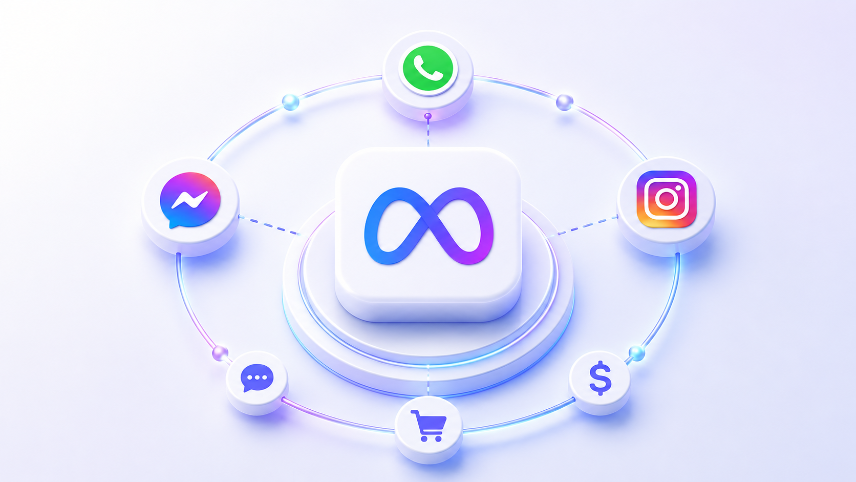
"Meta channels" simply means the three major messaging platforms owned by Meta (the company behind Facebook and Instagram):
- WhatsApp Business - the world's most-used messaging app, now central to customer support and order updates in most markets
- Instagram DM - where product discovery and buying questions happen, often triggered directly by a Story, Reel, or post
- Facebook Messenger - still widely used for customer service, especially among Facebook-page-driven businesses
Each of these started as a personal messaging app. Businesses were added later - which is exactly why they feel different from email or a contact form. A message on WhatsApp feels like texting a friend, not filing a support request.
Why customers prefer messaging over emails and phone calls
Three simple reasons keep showing up in customer behavior data and everyday experience:
- Speed - a message takes five seconds to send; an email takes a few minutes to compose properly, and a phone call requires you to actually talk to someone
- Familiarity - people already have these apps open all day for personal use; there's no new app to download, no login to remember
- Low friction - no forms, no ticket numbers, no "your call is important to us" hold music
When a customer has a choice between filling out a contact form or just typing "hi, is this in stock?" into WhatsApp, the outcome isn't close.
Why Meta Channels Are Becoming the Future of Customer Communication
This isn't a trend confined to one industry. It's showing up everywhere:
- A skincare brand running Instagram ads sees most buying questions land directly in DMs - not on the product page
- A jewelry store finds that WhatsApp is where customers ask about customization, sizing, and delivery timelines before committing to a purchase
- A furniture business gets Messenger inquiries asking for room-fit advice, something a static product listing can't answer
The common thread: customers are choosing to talk their way through a purchase decision rather than read their way through it. A chatbot that only lives on your website misses every one of these conversations, because the customer never even opened your website in the first place - they were on Instagram the whole time.
Why a Website Chatbot Alone Isn't Enough Anymore
A website chatbot is a good start. But it has a quiet limitation: it only works if the customer is already on your website.
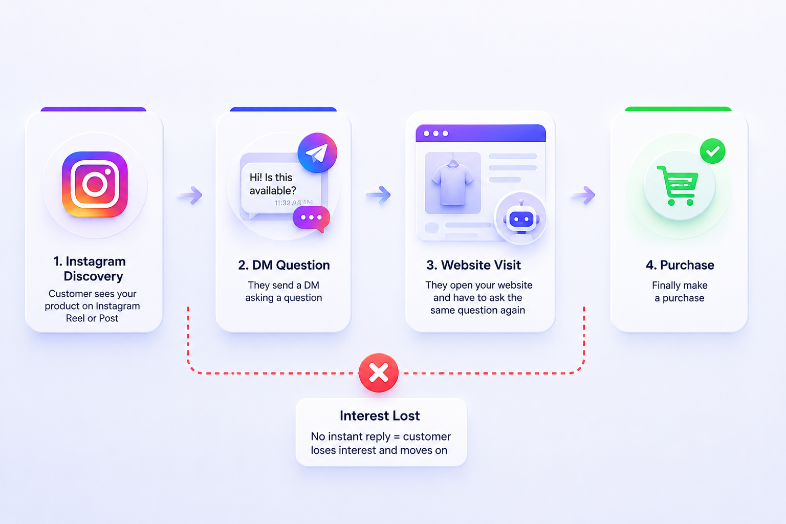
Here's the more common real-world path:
1. Customer sees your product on an Instagram Reel
2. They send a DM asking a question
3. They don't get an instant answer, so they open your website instead - or they simply move on
4. If they do land on your site, they now have to repeat the same question to a different chatbot, starting from zero
Every one of those steps is a place where interest can quietly disappear. A website-only chatbot solves the problem for people who reach the website. It does nothing for the much larger group of people whose entire conversation happens somewhere else - in the DMs where they first found you.
Benefits of AI Meta Channel Integration
Connecting WhatsApp, Instagram, and Messenger to one AI system changes what's actually possible for a growing business. Here's what it unlocks:
- 24/7 Support:No more "we'll get back to you within 24 hours." A customer messaging at 2 AM gets an answer at 2 AM.
- Instant Replies:The single biggest factor in whether a DM turns into a sale is response speed. AI replies in seconds, not hours.
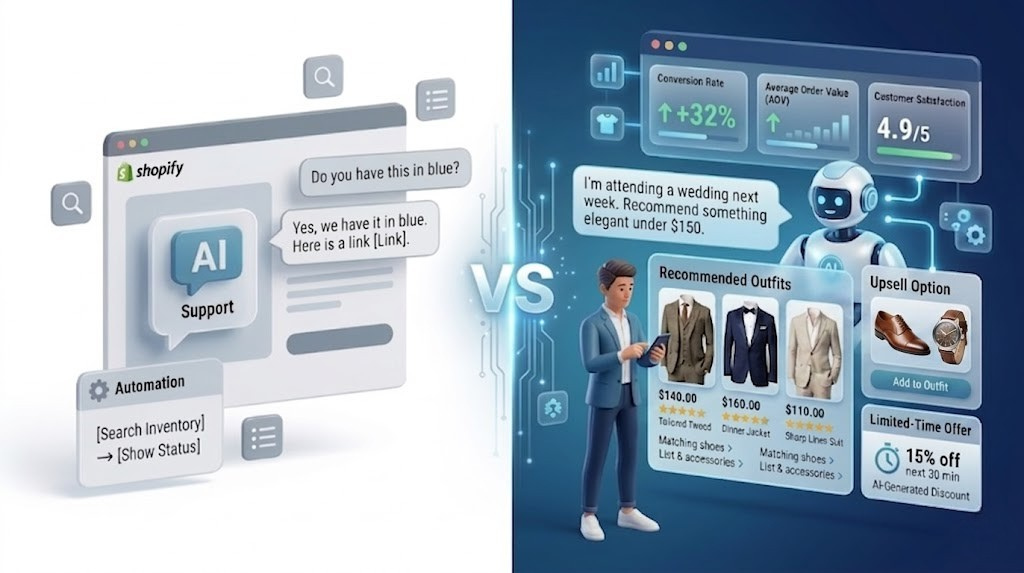
- Product Recommendations:Instead of a generic "check our website" reply, the AI can recommend the exact product - with an image, price, and a direct link to buy - based on what's actually in stock.
- Order Tracking:"Where is my order?" is one of the most common messages any online store receives. AI can answer it instantly by checking real order data, without a human ever getting involved.
- Lead Qualification:For service-based businesses, AI can ask the right follow-up questions (budget, timeline, requirements) before handing a warm lead to a sales rep.
- Appointment Booking:Salons, clinics, and consultants can let customers book directly inside a WhatsApp or Instagram conversation - no separate booking app required.
- FAQ Automation:Shipping policies, return windows, sizing charts - questions asked hundreds of times a month can be answered instantly and consistently.
- Sales Automation:From first question to checkout link, the entire buying conversation can happen without a human touching it - freeing your team for conversations that actually need a person.
- Personalized Conversations:Because the AI has access to real catalog and order data, replies feel specific to that customer, not copy-pasted.
- Multi-Language Support:A single AI system can reply in the customer's own language automatically, which matters enormously for brands selling across regions.
- Reduced Support Cost:Handling the repetitive 80% of questions automatically means your support team can focus on the 20% that genuinely need a human - without hiring more people as your message volume grows.
Industry Examples: How Meta AI Chatbots Actually Help
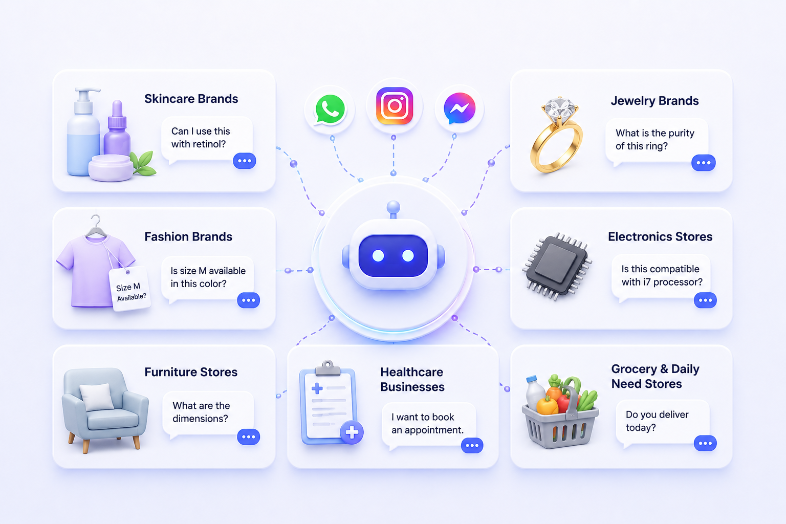
- Beauty brands:Customers frequently ask about skin type, ingredients, and combinations ("can I use this with retinol?"). An AI chatbot trained on the product catalog can answer confidently and recommend a matching routine, turning a single question into a multi-product sale.
- Jewelry brands:Purchases here involve trust and detail metal purity, sizing, customization options, delivery timelines. Instant, accurate answers on WhatsApp reduce the hesitation that often kills high-value purchases.
- Fashion brands:Size and fit questions dominate DMs. AI can pull real stock data ("yes, size M is available in three colors") instead of a generic "please check our size guide."
- Electronics stores:Technical questions (compatibility, specifications, warranty) need precise answers. AI trained on product specs prevents costly return rates caused by mismatched expectations.
- Healthcare businesses:Clinics and wellness brands use Meta channels for appointment booking and pre-visit questions, reducing no-shows and front-desk workload.
- Furniture stores:Big-ticket items mean longer decision cycles. AI can handle dimension questions, delivery timelines, and material details across multiple conversations before a customer is ready to buy.
- Grocery and daily-need stores:Fast, repetitive questions (stock availability, delivery slots, substitutions) are exactly what AI automation is built for - high volume, low complexity, high frequency.
A Real Customer Journey: Discovery to Purchase
Here's what a connected, AI-powered journey actually looks like end to end:
- Discovery:A customer scrolls Instagram and sees a Reel featuring a linen shirt
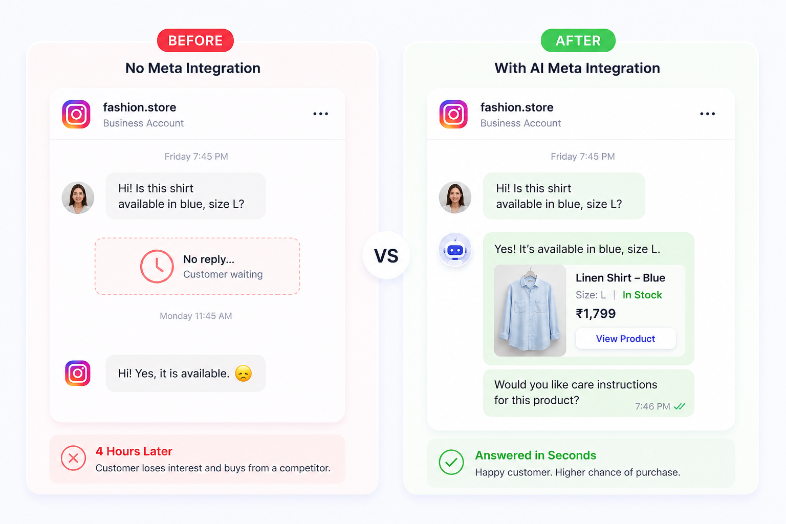
- First question:They DM: "is this available in blue, size L?" The AI replies instantly with stock confirmation and a product image
- Continuing the conversation:They ask a follow-up about fabric care. The AI answers, still inside Instagram
- Moving to the website:Curious to see the full collection, they click through to the site and the website chatbot already has context from the Instagram conversation, so they don't have to repeat themselves
- Purchase:The AI recommends a matching product, shares a direct checkout link, and the sale closes all without a single human reply
This is the difference between three disconnected tools guessing at what a customer wants, and one AI system that remembers the entire conversation.
Why Omnichannel AI Matters
The real value isn't just "having a chatbot on WhatsApp" and "having a chatbot on Instagram" as two separate tools. It's having one AI brain that powers Website Chat, WhatsApp, Instagram, and Messenger together - sharing the same product knowledge, the same conversation history, and the same customer context.
Without this, a customer who starts a conversation on Instagram and continues it on WhatsApp has to explain themselves twice. With true omnichannel AI, the system already knows what was asked, what was recommended, and where the conversation left off - regardless of which app the customer picks up on next.
This single detail is often what separates a smooth, high-converting customer experience from a frustrating, repetitive one.
Why Businesses Lose Sales Without Meta Integration
A few common, entirely preventable scenarios:
- A customer DMs a question on a Friday evening. No one replies until Monday morning. By then, they've bought from a competitor who answered in minutes.
- An Instagram ad drives hundreds of DMs a day. Only a fraction get answered before the customer loses interest - meaning ad spend is being wasted on conversations that go nowhere.
- A customer asks the same question on WhatsApp that they already asked on the website chatbot, gets a different (sometimes contradictory) answer, and loses confidence in the brand.
- Support tickets pile up because every "where's my order?" message requires a human to manually check order status - a task that should take zero human minutes.
None of these are edge cases. They're daily occurrences for any growing ecommerce or D2C brand - and each one is a direct, measurable revenue leak.
Future Trends: Meta Commerce from 2026 to 2030
Where this is all heading over the next few years:
- AI Shopping Assistants:AI won't just answer questions; it will actively guide customers through comparing products, building a cart, and completing checkout inside the chat itself
- Voice AI:Voice notes and voice replies inside WhatsApp will become a natural extension of text-based AI conversations
- AI Commerce:Buying directly inside a chat thread, without ever visiting a website, will become standard rather than novel
- Deeper Personalization:Recommendations will draw not just from what a customer asks, but from their full purchase and browsing history across every channel
- Autonomous AI Agents:AI won't just respond to messages; it will proactively follow up, recover abandoned conversations, and re-engage customers at the right moment
- Meta Business Automation:Meta itself continues investing heavily in business messaging tools, signaling that this is a long-term platform shift, not a passing trend
Businesses that build Meta Channel Integration into their operations now will be adapting incrementally over the next few years. Businesses that wait will be trying to catch up all at once.
Why ReComAI
ReComAI was built around exactly this shift - one AI system that connects everywhere a customer might reach out, instead of forcing a business to stitch together separate tools for each channel.
What that looks like in practice:
- Website AI Chatbot - answers product and support questions live on your site
- WhatsApp Integration - order updates, support, and product Q&A inside WhatsApp
- Instagram Integration - DM and Story-reply automation with real product recommendations
- Facebook Messenger Integration - the same AI, extended to Messenger conversations
- AI Product Recommendations - suggestions generated from your actual live catalog, not generic responses
- AI Knowledge Base - trained on your FAQs, policies, and product details so answers stay accurate
- Lead Capture - qualifying and collecting interested customers automatically
- AI Analytics - visibility into what customers are asking and how conversations convert
- Human Handover - when a conversation genuinely needs a person, your team steps in with full context, no re-explaining required
- Multi-Channel Conversations - one connected experience across every channel a customer chooses to use
The goal isn't to replace your team - it's to make sure no customer conversation, on any channel, ever goes unanswered.
Conclusion
Customer communication has already moved to messaging apps - this isn't a prediction, it's the current reality for most online businesses. The only open question is whether a business responds to that shift with one connected AI system, or keeps losing customers in the gap between Instagram, WhatsApp, Messenger, and the website.
Meta Channel Integration isn't a nice-to-have feature anymore. In 2026, it's closer to the baseline expectation customers already have - even if most businesses haven't caught up to it yet.
The businesses that do catch up early won't just save support hours. They'll capture the sales that would have otherwise gone to whichever competitor happened to reply first.
Frequently Asked Questions (FAQs)
Keywords