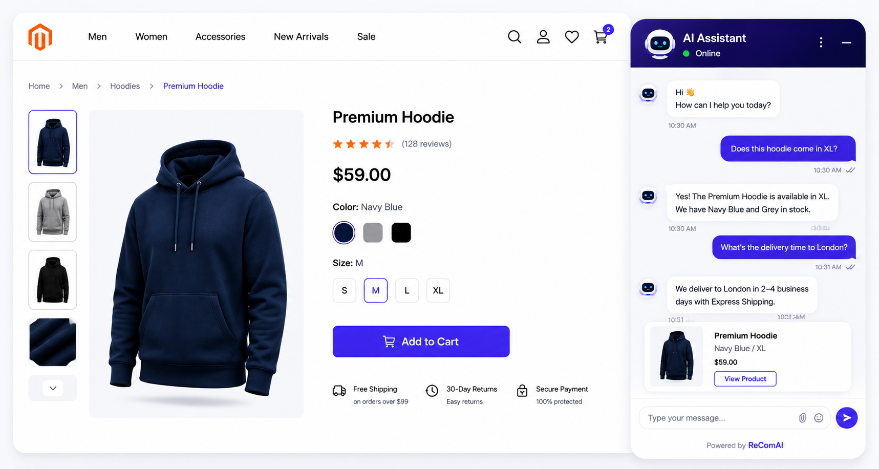
For years, Shopify stores ran two separate AI tools: one for product recommendations and sales, another for customer support. In 2026, that split is disappearing. The stores seeing the biggest gains aren't the ones with the fancier recommendation engine or the faster support bot — they're the ones running a single AI agent that does both, in the same conversation, with the same memory. Here's why that shift happened, and how to set it up.
The Old Model: Two Tools, Two Disconnected Experiences
For most of the last few years, a typical Shopify stack looked like this: a product recommendation app driving product suggestions and upsells, and a separate helpdesk or chatbot app handling returns, shipping questions, and order status. Two subscriptions, two dashboards, two AI "personalities" — and no shared memory between them.
The result was a shopping experience with an invisible wall in the middle of it. A shopper could ask the support widget "where's my order?" and get a perfectly good answer — and then that conversation would end there. The sales tool, sitting in a different widget or a different part of the page, had no idea that conversation happened. It kept showing the same generic recommendations it would have shown a first-time visitor.
The reverse was just as common. A shopper deep in a product-recommendation conversation would ask "does this ship to Canada?" — a support question — and the sales-focused AI either couldn't answer it accurately or answered from a generic FAQ that didn't reflect the store's actual policy.
What Changed in 2026
Two things converged. First, the underlying AI models got good enough to reliably hold both types of conversation — product discovery and policy/support questions — without needing separate, narrowly-trained systems for each. Second, merchants started noticing the cost of the split directly in their data: sessions that touched a support conversation almost never converted, not because the shopper wasn't ready to buy, but because nothing in the experience nudged them back toward buying once their question was answered.
Combining sales and support into one agent isn't a nice-to-have feature anymore — for stores running AI at all, it's become the baseline expectation. This isn't unique to Shopify either: the same pattern is showing up in comparisons of AI sales agents for Magento stores and in how WooCommerce stores handle cart abandonment — platforms differ, but the underlying shift toward one unified agent is the same everywhere.
What "Combined Sales + Support" Actually Means
A combined AI agent isn't a recommendation engine with an FAQ bolted onto it. It's a single conversational layer that carries context across three moments in the same session:
Pre-sales discovery and questions. The shopper asks what they're looking for, gets product matches, and can ask follow-up questions — including policy questions ("is this true to size?", "what's the return window?") — without the conversation breaking or switching to a different tone.
Checkout and cart assistance. The same agent can answer a shipping-cost or payment-method question at the moment of hesitation, and follow that with a relevant cross-sell, because it already knows what's in the cart and why the shopper paused.
Post-purchase support. Order tracking, return requests, and product questions from existing customers are handled by the same system — which also means it knows not to push a hard upsell at a shopper who's mid-way through a support issue.
The defining feature isn't any single capability — it's that all three share one memory of the conversation, instead of resetting every time the shopper's intent shifts from "buying" to "asking" and back again.
Why Separate Tools Create Blind Spots
Running sales and support as two disconnected tools creates specific, measurable problems:
No context handoff. A shopper who just asked about a return policy gets zero acknowledgment of that when the recommendation widget shows them products two minutes later. It's not personalized — it's just generic.
Wrong tone at the wrong moment. A separate sales tool doesn't know a shopper has an open complaint or a delayed order. It keeps surfacing upsell prompts to someone who's frustrated, which reads as tone-deaf rather than helpful.
Duplicate cost, inconsistent voice. Two subscriptions, two brand voices to configure and maintain, and often two different data sources for policies — which means the answers a shopper gets can actually conflict between the two tools.
Support conversations treated as a dead end. This is the biggest one. A support interaction is one of the highest-intent moments in the entire customer journey — the shopper cared enough to ask a specific question rather than leaving. Treating that as purely a cost center, rather than a moment that can lead back to a sale, is the single biggest inefficiency in the old two-tool model.
What a Combined Agent Does That Separate Tools Can't
It carries the objection into the recommendation. If a shopper asks about sizing and gets reassured, the same agent can immediately suggest the right size or a complementary product — in the same breath, without the shopper having to re-explain what they were looking at.
It adjusts tone based on session history. A shopper who's currently waiting on a delayed order shouldn't be pitched an upsell the moment they open a chat — a combined agent can recognize this and lead with support, not sales, until the issue is resolved.
It turns support into a recovery channel. If a shopper reaches out because a product was out of stock, the same conversation can offer a close alternative or a restock notification — something a pure helpdesk tool, with no visibility into live inventory or recommendation logic, typically can't do.
It reduces total setup and maintenance work. One knowledge base, one brand voice, one place to update policies — instead of keeping two systems in sync manually every time a shipping policy or return window changes.
Where This Shows Up Across the Shopify Journey
If you haven't set up the sales side of this yet, our AI product recommendations setup guide for Shopify covers the product-page layer in detail — this section builds on that foundation and adds the support layer on top.
| Stage | What Shows Up Here | What It Replaces |
|---|---|---|
| Product page | Product Q&A + discovery, sizing/fit questions | Separate FAQ widget with no product awareness |
| Cart page | Shipping/payment questions + relevant cross-sell in the same reply | Generic cart cross-sell block with no support capability |
| Checkout | Real-time objection handling (cost, trust, payment options) | Static FAQ link or no intervention at all |
| Post-purchase | Order tracking, returns, reorder suggestions | Disconnected helpdesk ticket with no product recommendation logic |
Setting Up a Combined Sales + Support Agent on Shopify
If you're using ReComAI on Shopify, here's how to configure a single agent to cover both sides properly.
Step 1: Connect Your Full Data Sources, Not Just Your Catalog
Most merchants connect their product catalog and stop there. For a combined agent, also connect your shipping policy, return policy, and order data via the ReComAI Shopify integration . Without this, the "support" half of the agent will fall back to generic answers instead of your actual policies.
Step 2: Define Both Conversation Modes in One Widget
In the ReComAI dashboard, under Agent Behavior, you'll find separate logic layers for Sales Mode (discovery, recommendations, and upsell/cross-sell and Support Mode (order status, returns, policy Q&A). Keep both active on the same widget — don't split them into two separate chat entry points. The goal is one conversation surface, not two.
Step 3: Set Escalation and Tone Rules
Configure a rule so that when a shopper's message indicates frustration, a delayed order, or an explicit request for a human, the agent shifts to a support-first tone and surfaces a clear path to a human agent rather than continuing to push product recommendations. This single setting prevents the most common complaint merchants have about combined agents — feeling "salesy" at the wrong moment.
Step 4: Connect a Messaging Channel for Continuity
If a shopper starts a conversation on your site and later follows up on WhatsApp or another channel, make sure the same conversation history carries over. Losing context between channels defeats the purpose of combining sales and support in the first place.
Step 5: Set Your Post-Resolution Recommendation Rule
Once a support question is fully resolved (a return is confirmed, an order status is given), configure the agent to offer — not push — a relevant next step: a restock nudge , a complementary product, or simply asking if there's anything else they're shopping for. This is what actually recovers revenue from support conversations, without feeling forced.
Step 6: Review Blended Analytics
Track revenue attributed to conversations that started as a support question, alongside your standard recommendation metrics. This is the number that proves whether the combined approach is working — a metric that's impossible to see when sales and support run as separate tools with separate dashboards.
Mistakes That Undermine a Combined Agent
Mistake 1: Bolting an FAQ onto a Sales Bot Instead of Truly Merging Them If the "support" side of your agent is just a few hardcoded FAQ answers layered on top of a recommendation engine, it will fail the moment a shopper asks anything slightly off-script. Feed it your actual policies, not a static FAQ page.
Mistake 2: No Clear Path to a Human Combined doesn't mean fully automated forever. Complex disputes, damaged items, and anything involving real money need a fast, visible way to reach a human. An agent that loops a frustrated shopper without an escalation option does more damage than two separate, simpler tools would.
Mistake 3: Pushing Upsells Mid-Complaint This is the fastest way to make a combined agent feel worse than two separate ones. If a shopper is mid-way through a support issue, hold the upsell until it's resolved — timing matters more than the recommendation itself.
Mistake 4: Not Measuring Support-Originated Revenue If you're not tracking revenue from conversations that started as a support question, you have no way to justify or improve the sales side of the combined setup — and no way to know if Mistake 3 is happening.
Mistake 5: Inconsistent Tone Across Channels If the widget on your site sounds different from the agent on WhatsApp, the "combined" experience breaks the moment a shopper switches channels. Keep the brand voice and knowledge base identical everywhere the agent shows up.
What Good Performance Looks Like
Realistic benchmarks for Shopify stores running a properly configured combined sales + support agent:
| Metric | Baseline | Good | Excellent |
|---|---|---|---|
| Support query resolution without human handoff | 50–60% | 60–75% | 75%+ |
| Revenue attributed to support-originated conversations | 3–6% of total | 6–12% | 12%+ |
| Post-resolution recommendation acceptance rate | 5–10% | 10–18% | 18%+ |
| Customer satisfaction (CSAT) on AI-handled conversations | 70–80% | 80–90% | 90%+ |
If revenue attributed to support-originated conversations is near zero, it's almost always because Step 5 above (offering a next step after resolution) isn't configured — not because shoppers who ask support questions aren't willing to buy.
The One Thing Most Guides Skip
Support conversations are treated, almost universally, as a cost to minimize — a queue to clear as fast as possible. That framing misses what's actually happening: a shopper who messages you with a specific question is one of the most engaged visitors on your entire site. They didn't bounce. They didn't abandon silently. They asked.
A combined agent is the only setup that can actually capture the value of that engagement, because it's the only setup where the same system that answered the question can also, naturally and without friction, help the shopper finish what they came to do. Two separate tools can't do this — not because the individual tools are bad, but because the value sits precisely in the handoff between them, and a handoff between two disconnected systems is exactly what shoppers fall through.
Frequently Asked Questions
Next Steps
If you're currently running separate sales and support tools on Shopify, the highest-leverage first move isn't picking a side — it's checking whether your current support conversations lead anywhere at all once the shopper's question is answered. If the answer is "no, the conversation just ends," that's the gap a combined agent closes first.
To see how ReComAI can run both sides of this for your store's actual catalog, policies, and traffic, you can book a 30-minute walkthrough using the link below, or start a conversation on WhatsApp.
Keywords