Seven out of ten shoppers abandon their cart. Not because your price is too high. Not because they didn't like your products. They leave because they don't trust you enough, and their one unanswered question walks out the door with them.
That's the conversion bottleneck in 2026. Traffic is cheaper than ever. Trust is what's actually scarce. And if you're not actively building it, you're leaving money on the table — sometimes hundreds of thousands of dollars annually.
This is the ecommerce trust stack. It's the combination of signals and tools that convince a shopper you're real, your products deliver, and you won't disappear after they pay. Every layer removes a different doubt. And when you layer them properly, the shoppers who would have abandoned suddenly convert.
Let's break down what actually works, and why most stores are still getting it wrong.
What is the Ecommerce Trust Stack?
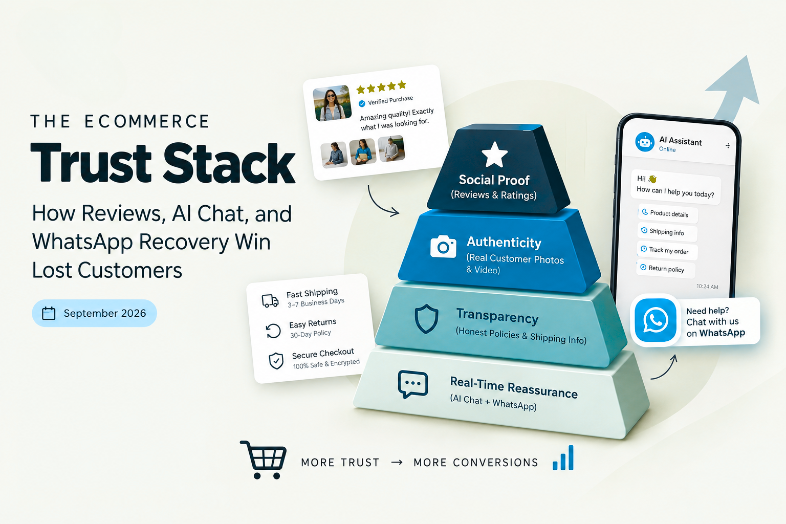
The ecommerce trust stack is four layers of proof:
Layer 1: Social Proof (Reviews & Ratings) Proof that the product actually works. Other customers bought it. They liked it. They came back.
Layer 2: Authenticity (Real Customer Photos & Video) Proof that it works in real life, not just in professional studio shots. Your size. Your body. Your use case.
Layer 3: Transparency (Honest Policies & Shipping Info) Proof that you're not hiding surprises. Clear shipping costs. Clear return terms. Clear refund timelines.
Layer 4: Real-Time Reassurance(AI Chat + WhatsApp) Proof that you're available right now to answer the one specific question blocking this particular purchase.
Each layer removes a different doubt. None of them work alone.
A five-star rating means nothing if the shipping cost is hidden. A beautiful product photo doesn't matter if there's no way to ask about sizing. Professional chat feels like theater if you're not answering WhatsApp messages where customers actually are.
The stores that convert 2x more than their competition don't have better products. They have better trust. And it's built deliberately.
Why Trust, Not Traffic, is the Real Bottleneck
Here's the brutal truth: you can buy an infinite amount of traffic. Google Ads, TikTok Shop, Instagram ads — technology made it cheap to get visitors onto your store.
But you can't buy trust. Not credibly, anyway.
The numbers tell the story:
- 70.22% of shopping carts are abandoned (Baymard Institute, 2025)
- 39% of those are abandoned because of unexpected shipping, tax, or fees discovered at checkout
- 2 out of 3 consumers trust online reviews less than they did 5 years ago
- 90% say fake reviews are a concern
- 50% have abandoned a purchase because they couldn't find enough product information
Traffic is broken. Shoppers show up skeptical, armed with smartphone AI assistants that can vet your reviews and policies before they ever land on your page. Generic marketing copy doesn't move them anymore.
So the real conversion lever isn't "more traffic." It's closing the trust gap on the traffic you already have. That's cheaper, and it compounds — because a customer who trusts you buys again.
Layer 1: Social Proof (Reviews Close the Trust Gap)
Customer reviews are the single most effective signal you can add to a store. The data isn't even close.
Products with 5 reviews are 270% more likely to sell than products with zero reviews.
On high-priced items, the lift is even higher: 380% conversion increase (Medill Spiegel Research Center, 2025).
But here's what most stores get wrong: they think volume matters.
It doesn't. Authenticity matters.
A verified-buyer badge alone adds 15% to purchase odds. Shoppers rank authenticity as the #1 factor when deciding which reviews to trust. Five genuine reviews from customers who actually bought the product beat 50 anonymous 5-star raves that look fake.
How to Get Real Reviews (Without Asking Everyone to Call You):
- Automate the request — Send a post-purchase email 5-7 days after delivery asking for a review. Time it for when the product has been used.
- Make it easy — Don't ask for a novel. A quick rating + one-sentence comment is enough. Photos are optional, but they convert like crazy.
- Reward authenticity, not perfection — A product with 4.2 stars and honest three-star reviews looks real. 4.9 stars with 500 reviews and zero critical feedback looks manufactured.
- Display where it counts — Show reviews on the product page itself, not buried in a separate tab. The shopper asking "should I buy this?" isn't going to hunt for proof.
- Never, ever buy reviews — Fake reviews are increasingly illegal, and they destroy trust faster than having no reviews at all.
Review platforms like Kudobuzz or native Shopify review apps automate this process, collecting verified reviews and displaying them as star ratings, written feedback, and Q&A across your store.
Layer 2: Authenticity (Customer Photos Beat Your Product Photography)
Professional product photography is important. It sells the ideal version of your product — perfect lighting, perfect fit, perfect angle.
Customers don't buy the ideal. They buy what actually shows up at their door, and what it looks like on their body, in their home, under normal light.
Shoppers who engage with customer photos convert at 90% higher rates than those who only read text (PowerReviews, 2025).
Why? Customer photos answer questions studio photography can't:
- "What does this actually look like off the model?"
- "Does the color match what I'm seeing on screen?"
- "How would this fit MY body shape?"
- "How are other people actually styling/using this?"
- "Is this product a scam or is it legit?"
That last one is the unspoken question. Real customer photos are the fastest way to answer it.
How to Get Customer Photos:
- Ask after delivery — Include a link to upload photos in the post-purchase email or packing slip.
- Make it frictionless — Let customers upload directly from their phone without creating an account.
- Offer a small incentive — A 10% discount on their next order, or entry into a monthly draw. You're not bribing them to lie; you're thanking them for content you can use.
- Display prominently — Show customer photos at the top of the product page, right next to your studio shots. Let new customers see the reality before they commit.
- Include in email campaigns — Customer photos have insane open rates. A customer is way more likely to click an email featuring real people wearing/using the product than your brand's perfect product shot.
Layer 3: Transparency (The Trust Layer Every Store Hides)
Here's why people abandon carts: they're shocked by the cost.
39% of cart abandonment happens specifically because of unexpected shipping, taxes, or fees discovered at checkout (Baymard Institute, 2025).
The crazy thing? The cost itself usually isn't the problem. The surprise is.
Shoppers don't expect free shipping or unlimited free returns from every store. They do expect honesty about what they're getting into.
How to Build the Transparency Layer:
On Product Pages:
- Show estimated delivery windows (example:"Arrives in 2-5 business days")
- Show shipping cost or "Free shipping for orders over $75"
- Link clearly to returns and exchange policy
- Show refund timeline (example:"Refunded to your original payment method within 5-7 business days")
In Navigation:
- Make shipping, returns, and refund policies immediately findable in the footer
- Don't bury them in a legal FAQ no one reads
- Use plain English, not legal jargon
At Checkout:
- Show calculated shipping before payment
- Show any taxes or fees clearly
- Remind them of the return window one more time
- Display trust badges (more on those in a moment)
The bonus: Your reviews will mention real shipping speed and return experiences. Your AI agent can answer WISMO (Where Is My Order?) and delivery questions instantly. Transparency layers actually reinforce each other.
Layer 4: Real-Time Reassurance (AI Chat + WhatsApp)
Reviews prove the product is good. They can't tell one specific shopper whether it's right for them.
That's where AI chat lives. It's the difference between "generally trustworthy" and "this store is going to solve my problem right now."
The Two Questions AI Chat Answers:
Question 1: "Is this right for me?"
- Will this fit me (sizing, materials, compatibility)?
- Will it arrive in time (delivery windows)?
- Can I return it (refund and exchange policy)?
Question 2: "Can I talk to someone right now?"
- Half of buyers have abandoned purchases because they couldn't find enough product information (Syndigo, 2024)
- When a question goes unanswered, the shopper leaves to search competitors
- They often don't come back
Shoppers who engage with AI chat are 4x more likely to buy than those who don't (Rep AI, 2025).
But here's the critical part: the AI has to be smart. It can't be a scripted bot running canned answers.
Why Most Chat Bots Fail (And How to Build One That Actually Works):
Bad Chat Bot:
- Runs from a scripted decision tree
- Can't see your actual inventory, policies, or order data
- Answers confidently and wrongly
- Destroys trust faster than no chat at all
Good AI Agent:
- Reads your live catalog, policies, and customer data
- Understands sizing, shipping, and return questions in context
- Can check if something's in stock RIGHT NOW
- Can explain your specific refund timeline, not a generic one
- Works 24/7, in 95+ languages
- Connects to multiple channels:website chat, WhatsApp, Instagram, email
The difference is whether the AI has real data or just generic knowledge.
WhatsApp: Where Your Customers Actually Are (And Most Stores Ignore It)
Here's a fact that still surprises stores: more people use WhatsApp than email. Way more.
WhatsApp has 2 billion monthly users. Most of your customers have it open on their phone right now. They prefer it for business communication. They'll respond faster on WhatsApp than email. They trust it because they use it with friends and family.
But most ecommerce stores don't have a WhatsApp presence. So when a customer has a question at midnight, or after your support team is offline, they abandon.
Why WhatsApp Changes the Trust Equation:
- It's where customers are — They already have it open. They'll message you there before trying email.
- It's faster — Chat responses show up immediately. A customer doesn't have to wait for an email tomorrow.
- It's more personal — WhatsApp feels like texting a friend. It's lower-pressure than live chat on a web page.
- It's available 24/7 — An AI agent on WhatsApp doesn't sleep. It answers sizing questions at 11 PM, confirms shipping at 2 AM, and recovers abandoned carts at 3 AM.
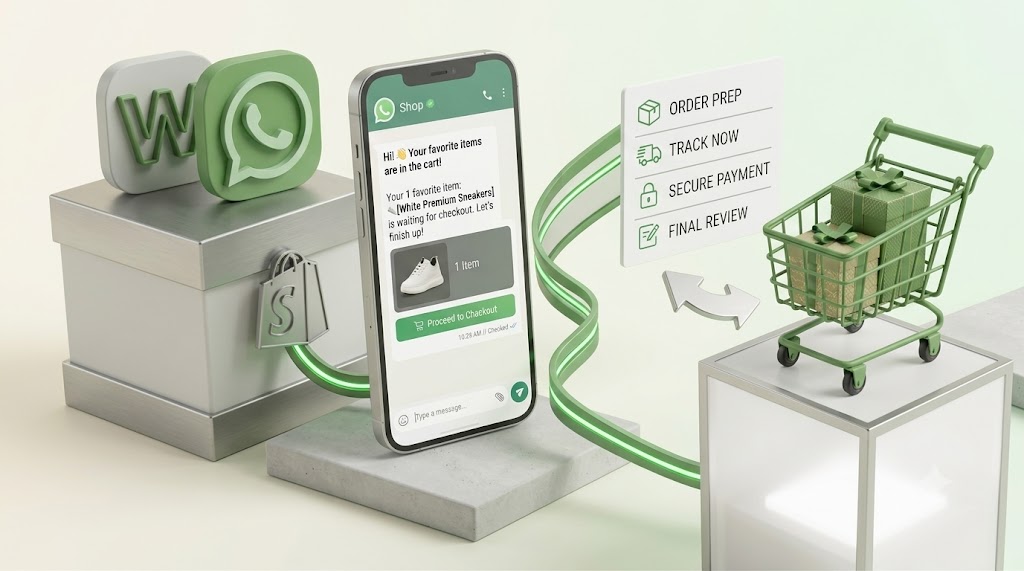
- It recovers carts — Abandoned cart reminders on WhatsApp have way higher open rates than email. A customer who left your store gets a message 2 hours later, sees your AI chat answer one lingering question, and completes the purchase from their phone.
The Two Questions That Matter: Reviews vs AI Chat
These aren't competitors. They answer different questions at different moments. The strongest stores run both.
| Dimension | Reviews | AI Chat |
|---|---|---|
| Question answered | "Can I trust this product?" | "Is this right for me?" |
| When it works | Before browsing & during comparison | The moment a specific doubt appears |
| Coverage | Shared, repeated concerns | Personal, specific, high-stakes questions |
| Format | Static proof on the page | Live, back-and-forth conversation |
| Best on | Every product, especially high-priced | Complex, high-consideration items |
Reviews build baseline credibility. A new visitor lands on your site and sees 4.7 stars with 200 reviews. They're 60% of the way there.
AI chat closes the remaining 40%. That same customer reads reviews, looks at photos, then asks "will this fit XL?" or "can it arrive by Friday?" The AI answers instantly. The customer buys.
Remove either layer, and you lose a distinct slice of buyers.
Trust Badges: The Final Layer at Checkout
Trust badges are small visual marks — security seals, payment icons, trust logos — that tell a shopper your store is safe. They're especially powerful right at checkout, where hesitation peaks.
Types of Trust Badges (And Where They Matter):
- Security Badges (Near the checkout button)
- - Encryption symbols, PCI compliance marks
- - Tell shoppers their card details are protected
- - "This connection is secure"
- Payment Badges (Payment method section)
- - Visa, Mastercard, PayPal, Apple Pay logos
- - Familiar logos reduce buyer hesitation
- - "I can pay the way I trust"
- Policy Badges (Shipping/returns section)
- - Money-back guarantee, free returns, secure checkout
- - Repeat your promises as visible stamps
- - Endorsements from third parties (BBB, Google, Trustpilot)
Badges work best when:
- - Your site loads fast (they're useless if you're slow)
- - Your design is clean (they look out of place on cluttered pages)
- - They're placed strategically (near relevant sections, not randomly scattered)
Most Shopify stores have thousands of badge and widget apps available. Adding badges is straightforward. Just make sure they're real (actual security certifications, actual payment methods you accept, actual guarantees you're willing to back).
Why Reviews and AI Chat Compound (The Real Conversion Math)
Let me walk you through a real decision: A customer is shopping for running shoes. They:
- See a 4.7-star rating
- Read a dozen reviews about comfort and durability
- Scroll through customer photos showing the shoes on real feet
- Check the color against their other gear
They're almost ready to buy. Then one question stops them: "Which size should I choose?"
Without AI chat: They open a new tab. Search a competitor. See if anyone there answers sizing. Momentum lost. Your traffic budget wasted. Sale goes to someone else.
With AI chat: They ask instantly. The agent recommends a size based on other customers' feedback, confirms delivery by Saturday, explains the free-return policy, and maybe suggests matching socks. They buy, right there, because every doubt just got answered.
The math of it:
Monthly Revenue = Traffic × Conversion Rate × AOV
Example:
- 30,000 product-page sessions per month
- 2.8% conversion rate
- $70 average order value
= $58,800/month
Add the trust stack (reviews + AI chat):
- Conversion rate climbs to 3.3%
= 30,000 × 0.033 × $70 = 69,300/month=+10,500/month = +$126,000/year
From the same traffic your ads already paid for.
That's not growth hacking. That's just not leaving money on the table.
When the Trust Stack Backfires (And How to Avoid It)
Trust is fragile. Build it wrong, and it breaks worse than if you hadn't tried.
Fake Reviews (The Credibility Killer)
- The problem:A wall of 5-star reviews with no verified badges and no critical feedback screams "fake." With 90% of consumers worried about review manipulation (PowerReviews, 2025), your perfect score is a red flag, not a win.
- The fix:Show verified-buyer badges. Keep the honest 3-star and 4-star reviews visible. Never, ever buy reviews. A product with 200 reviews averaging 4.3 stars looks real. A product with 500 reviews averaging 4.9 stars looks manufactured.
Incompetent AI Chat
- The problem:An AI agent that can't see live inventory or current policy will answer confidently and wrongly. "This item is in stock" — but you just sold out. "Your refund will take 3 days" — but it actually takes 7. That's worse than no chat at all.
- The fix:Connect your AI agent to real catalog data, live inventory, actual policies, and order information. Test it before launch. Monitor its answers for the first month. And crucially: if it gets something wrong, update the data it's reading from, not just the bot's script.
Hidden Policies (The Silent Killer)
- The problem:Transparency backfires only when it's missing. Burying your shipping cost, return deadline, or refund timeline until checkout doesn't build trust — it destroys it the moment the customer sees it.
- The fix:Make policies impossible to miss. Surface them on product pages. Link to them in navigation. Remind customers at checkout. The more transparent you are about the boring stuff, the more trust you earn on the exciting stuff.
The Ecommerce Trust Stack, Practically Speaking
If you implement nothing else, implement these five things, in this order:
- Get verified reviews on every product (Start with high-price, high-traffic items) Use a platform like Kudobuzz or Yotpo. Automate review requests. Prioritize verified-buyer badges.
- Turn on photo and video reviews (Ask post-purchase) More powerful than written reviews alone. Customers will use these to shop your store for the next year.
- Add AI chat trained on your actual store (Point it at your catalog and policies) Zipchat, HubSpot, ReCoMAI — whatever tool you pick, make sure it reads your actual data, not generic knowledge.
- Put AI chat on WhatsApp (Not just your website) Your customers are on WhatsApp. Abandoned cart recovery is way more effective via WhatsApp than email. 24/7 availability is the game-changer.
- Surface shipping and returns before checkout(Kill the late-stage surprise) Show costs upfront. Link to policies. Remind customers of the return window. The 39% abandonment rate from unexpected costs drops when costs aren't unexpected.
The Future of Trust in Ecommerce (Where This is Heading)
Two massive shifts are already underway:
Shift 1: AI Pre-Shopping Shoppers now vet stores through AI assistants before they even visit. Google Lens, ChatGPT plugins, specialized shopping AIs — they all summarize reviews and policies for customers automatically. This means your review content and policy pages have to be machine-readable, not just human-readable.
Shift 2: Chat that Actually Acts AI chat is moving beyond answering questions to actually enabling purchases. Confirming fit. Checking live stock. Applying discounts. Guiding checkout. The AI isn't just informative; it's a conversion tool.
The stores that win the next 2-3 years won't be the ones with the most traffic. They'll be the ones whose trust signals are consistent everywhere: in Google AI summaries, on product photos, in WhatsApp messages, at checkout. Trust is becoming the product's packaging. Ship it deliberately.
FAQ: Common Questions About Building Trust
The Bottom Line: Build Trust Deliberately
Trust isn't one feature you bolt on. It's an experience you deliberately assemble, layer by layer.
Layer 1 proves your product delivers. Layer 2 shows it works in real life. Layer 3 removes the surprises. Layer 4 answers the one question standing between a shopper and checkout.
Miss any layer, and the doubt it was meant to cover walks out with the customer.
For most Shopify stores, the move is simple:
- Collect verified reviews (Kudobuzz, Yotpo, or native reviews)
- Enable photo/video reviews
- Deploy AI chat trained on your store (ReCoMAI, Zipchat, or similar)
- Put that AI on WhatsApp for 24/7 cart recovery
- Make shipping and return policies impossible to miss
That's the trust stack. It doesn't require genius. It requires consistency. And the shoppers who would have abandoned? They suddenly convert.
Ready to build your trust stack? Most of these tools integrate with Shopify in minutes. Start with reviews, then add chat. The revenue lift compounds.
Keywords