
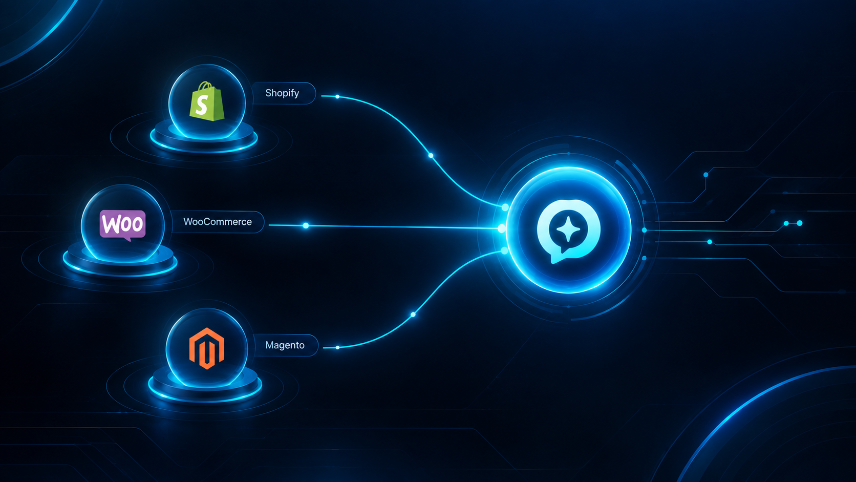
Ask a Shopify merchant, a WooCommerce store owner, and a Magento developer what their biggest conversion problem is, and you'll usually get three different answers about theme speed, app conflicts, or checkout customization. But underneath all three stores, there's one problem that looks identical no matter which platform you're on: shoppers can't find what they're actually looking for, and the store has no good way of understanding what that even means.
The Problem That Doesn't Care Which Platform You're On
Product discovery isn't a Shopify problem, a WooCommerce problem, or a Magento problem — it's an eCommerce problem that just happens to show up slightly differently depending on which platform's default tools you're stuck with.
A shopper who types "something for dry skin under $30" into a Shopify search bar gets the same disappointing result as one who types it into WooCommerce's built-in product search, or into Magento's layered navigation filters: nothing, or worse, an irrelevant grid of everything tagged "skincare." None of the three platforms' native search tools were built to understand intent — they were built to match keywords against product titles and tags, which is a fundamentally different job.
This is the pattern worth noticing: the specific tools differ by platform, but the underlying failure is identical everywhere. That matters, because it means the fix isn't a platform-specific trick — it's a different kind of layer entirely, one that happens to need a slightly different installation process depending on which stack you're running.
What "Product Discovery" Actually Means (And Why Default Tools Miss It)
Before comparing platforms, it's worth being precise about what's actually missing.
Real product discovery does three things simultaneously, none of which native search or static recommendation blocks do well:
Understands natural language, not just keywords. A shopper asking "I need a lightweight jacket for spring hiking" is describing a need, not a product name. Native search on all three platforms is built around matching query terms to product fields — it doesn't parse intent, so anything that isn't a near-exact keyword match returns weak or empty results.
Carries context across the conversation. A shopper who searches for "running shoes" and then asks "which one is better for wide feet?" is still talking about the same search — but reloading a new query on any platform's native search treats it as an unrelated request, with no memory of what came before.
Uses real behavioral and purchase data, not static rules. Manually curated "related products" fields (present on all three platforms in some form) reflect what a merchandiser guessed once, not what customers actually buy together. That gap only widens over time as a catalog grows and buying patterns shift.
How Each Platform Tries to Solve This Natively — And Where It Falls Short
| Platform | Native Tool | Where It Falls Short |
|---|---|---|
| Shopify | Search & Discovery app, static "related products" blocks | Basic catalog-structure matching; limited session awareness; no conversational layer |
| WooCommerce | Default WordPress search, manual Cross-sells/Up-sells fields | Purely keyword-based search; manually assigned recommendations that never update themselves |
| Magento / Adobe Commerce | Layered navigation, native Product Recommendations module | Behavioral and catalog-data driven, but still rule-based at the core; no natural-language understanding |
The details differ, but the shape of the gap is the same across all three: a reasonable starting point that works fine for shoppers who already know the exact product name, and breaks down for the much larger group of shoppers who are describing a need instead of naming a product.
Why This Problem Persists Regardless of Platform
Three underlying reasons explain why product discovery stays broken even on stores that have otherwise invested heavily in their platform:
Search and recommendations are treated as separate systems. On most stores, the search bar and the "related products" block are built and maintained independently, with no shared understanding of the shopper's session. A shopper who searched for one thing and is now looking at a completely different recommended product isn't a coincidence — it's two disconnected systems working in isolation.
Catalog data quality is inconsistent everywhere. This is genuinely platform-agnostic. Whether it's Shopify, WooCommerce, or Magento, if product titles are generic, descriptions are thin, and attributes are inconsistently filled in, every discovery tool — native or AI-powered — has less signal to work with, and recommendations suffer as a direct result.
Native tools are built for the platform, not for the shopper. Each platform's default search and recommendation tools are designed to work reasonably well out of the box across millions of different stores. That breadth comes at the cost of depth — none of them are built to understand your specific catalog's language, your specific customers' behavior, or your specific product relationships the way a dedicated AI layer can.
What a Unified AI Layer Does Differently
A dedicated AI product discovery layer — like ReComAI — solves this the same way regardless of which platform it's connected to, because the underlying problem is the same regardless of platform:
It understands intent, not just keywords, turning "something for dry skin under $30" into an actual filtered, relevant set of products, rather than an empty results page.
It carries session context automatically, so a follow-up question stays connected to what the shopper was already looking at, instead of resetting with every new message.
It learns from real purchase and behavioral data continuously, rather than relying on a manually assigned recommendation set that stays exactly as good — or as outdated — as the day it was configured.
Because the AI layer sits on top of the platform rather than being built from the platform's own native tools, the experience for the shopper ends up nearly identical whether the store is running on Shopify, WooCommerce, or Magento — even though what's happening underneath (the specific integration, the specific admin panel) looks different on each one.
Setting Up AI-Powered Product Discovery — Platform by Platform
The core setup logic is the same everywhere: connect your catalog and order history, activate recommendation and discovery zones on your highest-intent pages, configure fallback rules for new products, and set a clear revenue goal. The exact steps differ slightly by platform:
- Shopify — Install directly from the Shopify App Store and connect zones through a visual editor. See our full AI product recommendations setup guide for Shopify
- WooCommerce — Install as a WordPress plugin, no code required. See our no-code setup guide for WooCommerce.
- Magento / Adobe Commerce — Connect via the official extension module or API for custom themes. See our comparison of AI recommendation extensions for Magento
If you're deciding between a broader AI sales agent rather than a recommendation-only tool, our platform-specific rankings cover that comparison directly: top AI sales agents for Magento, top AI sales agents for WooCommerce , and how combining sales and support in one agent plays out specifically on Shopify.
Mistakes That Show Up on Every Platform
Mistake 1: Fixing Search Without Fixing Recommendations (or Vice Versa) Treating search and recommendations as separate projects recreates the same disconnected-system problem with a different tool. A shopper's session should carry context between the two, regardless of platform.
Mistake 2: Ignoring Catalog Data Quality This is the single most platform-agnostic mistake. Generic titles, thin descriptions, and inconsistent attributes limit any AI system's accuracy — on Shopify, WooCommerce, and Magento equally.
Mistake 3: Assuming One Platform's Setup Guide Applies Directly to Another The underlying AI logic is the same, but placement, admin panels, and configuration steps differ meaningfully between platforms. Follow the platform-specific setup rather than assuming a Shopify walkthrough maps one-to-one onto Magento.
Mistake 4: Leaving New Products or New Stores Without Fallback Rules Every platform's AI recommendation tool hits the same cold-start problem — not enough order data yet to make confident suggestions. Category-level fallback and manually assigned starting groups matter everywhere, not just on one platform.
Mistake 5: Never Reviewing What's Actually Being Recommended This applies regardless of platform — a monthly spot-check of top product pages catches mismatched pairings before they quietly suppress conversion for months.
What Good Product Discovery Looks Like, Across Platforms
Realistic benchmarks for stores with AI-powered product discovery properly configured — consistent within range regardless of underlying platform:
| Metric | Typical Range | Good Performance |
|---|---|---|
| Search-to-Product-View Conversion | 20–35% | 35%+ |
| Recommendation Click Rate | 7–15% | 15%+ |
| AOV Lift (vs. native search + static recommendations) | 10–25% | 25%+ |
| Zero-Result Search Rate | 15%+ | Under 5% |
The "zero-result search rate" is worth tracking specifically — it's the clearest, most platform-agnostic signal of a broken discovery experience, and it's a number every platform's analytics can report.
Frequently Asked Questions
The Takeaway
The specific tool names change depending on which platform you're running — Shopify's Search & Discovery, WooCommerce's default search and manual Cross-sells fields, Magento's layered navigation and native Product Recommendations — but the underlying failure is the same everywhere: none of these were built to understand what a shopper actually means, only what they typed.
That's why the fix looks the same across all three platforms too, even though the installation steps differ. A unified AI layer that understands intent, carries session context, and learns continuously from real purchase data solves the same problem regardless of which platform it's sitting on top of.
Next Steps
If you're running any of these three platforms and haven't audited your zero-result search rate recently, that's the fastest way to see how much of a problem this actually is for your store today. From there, the platform-specific setup guides linked above walk through the exact steps for your stack.
To see how ReComAI handles product discovery specifically for your catalog — regardless of whether you're on Shopify, WooCommerce, or Magento — you can book a 30-minute walkthrough using the link below, or start a conversation on WhatsApp.
Keywords