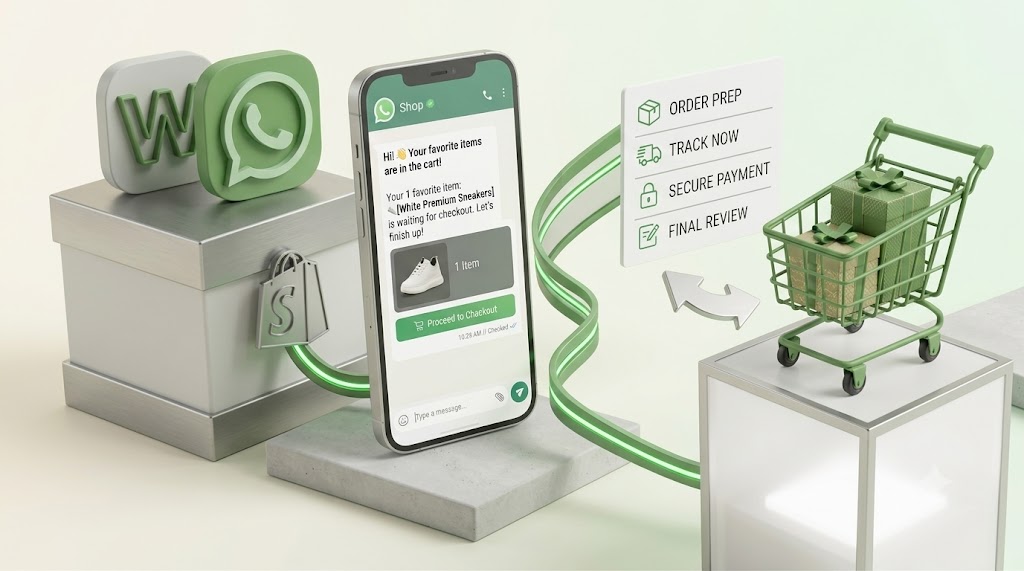
A shopper adds something to their cart, gets distracted by a phone call or a notification, and never comes back. That cart isn't a lost sale — it's a warm buyer who got interrupted mid-decision. The question is whether your store has a way to reach them on the one channel they'll actually open.
Why Cart Abandonment Is a Bigger Opportunity Than a Problem
Most Shopify merchants know their abandonment rate is high, but few treat it as the highest-leverage fix available to them. Industry research consistently puts average cart abandonment above 70% across online stores — meaning roughly seven out of every ten shoppers who add something to their cart never complete the purchase. Email has traditionally been the default recovery channel, but inbox fatigue and low open rates mean most recovery emails simply never get seen.
WhatsApp changes that math. Business messages on WhatsApp are widely reported to see open rates in the 90%+ range, compared to the 20–25% typical of email. That gap is exactly why WhatsApp cart recovery has become one of the fastest-growing categories of Shopify app in the last two years — and why choosing the right one matters more than treating them as interchangeable.
Below is a ranked look at five WhatsApp marketing and chat apps worth considering for Shopify cart recovery in 2026.
What a Good WhatsApp Cart Recovery App Actually Needs
Before ranking anything, it's worth being specific about what separates a genuinely useful tool from a basic notification sender:
Official WhatsApp Business API access. This is non-negotiable for automated, at-scale messaging — it keeps your number compliant and your messages actually deliverable, rather than relying on workarounds that risk getting a number blocked.
More than a single reminder message. The strongest tools don't just fire one generic "you left something in your cart" text — they support a short, well-timed sequence, and ideally let the conversation continue naturally if the shopper replies with a question.
Context, not just a link. A recovery message that references the specific product, current stock, or an honest reason to come back outperforms a generic nudge every time.
A path beyond the cart. The strongest tools don't stop at recovery — they can also field a support question, suggest an alternative if something's out of stock, or carry the conversation through to a completed sale rather than ending at "here's your link."
How We Ranked These Apps
This comparison focuses on:
- Official WhatsApp Business API access and deliverability
- Depth of cart recovery logic (timing, personalization, sequencing)
- Whether the tool can hold a real conversation, not just send a template
- Broader capability beyond recovery (support, catalog, broadcasts)
- Ease of setup on Shopify
- Pricing accessibility for smaller stores
Top 5 Shopify WhatsApp Marketing & Chat Apps — Ranked
1. Dondy

Best for: Getting started with WhatsApp recovery without upfront cost
Dondy positions WhatsApp as both a sales and support channel for Shopify stores, offering automated abandoned-cart recovery alongside a manual, one-click option for merchants not ready to fully automate. It runs on the official WhatsApp API and pairs recovery with an AI chatbot and a multi-agent inbox that shows order context alongside each conversation.
Why it stands out:
- A genuinely usable free plan, including unlimited conversations and a WhatsApp chat button
- Manual recovery option alongside full automation, useful for testing before committing
- Multi-agent inbox pulling in Shopify order details during live chats
- Review-collection integrations (Judge.me, Loox, and similar tools) built into the same app
Watch out for: Deeper automation and broader AI capability are more limited on the free tier compared to fully paid, sales-focused competitors.
2. Kanal

Best for: Mapping the entire customer journey, not just recovery
Kanal is built around a visual, no-code automation builder that connects welcome messages, cart recovery, upsells, and win-back campaigns into a single designed flow, backed by a conversational AI agent that can respond in a large number of languages.
Why it stands out:
- Visual flow builder covering the full WhatsApp journey, not recovery alone
- Multilingual AI agent capable of answering questions and suggesting products
- Shared inbox with Shopify order context, tagging, and quick replies
- A free plan is available to start testing
Watch out for: Building out well-designed flows takes more setup time than a single-message recovery tool — better suited to merchants ready to invest in the full journey rather than a quick fix.
3. DelightChat

DelightChat functions more like a WhatsApp-centered CRM than a narrow recovery tool, combining segmented broadcasts, cart and checkout recovery, and a unified inbox that spans WhatsApp, Instagram, Facebook, email, and live chat.
Why it stands out:
- Recovery messages sent through a verified, official API number
- COD verification and COD-to-prepaid flows, useful for stores with a high share of cash-on-delivery orders
- A single inbox covering multiple channels, not WhatsApp in isolation
- Built-in analytics separating support-driven and recovery-driven revenue
Watch out for: No free plan — evaluate the trial period carefully against your store's actual cart volume before deciding.
4. KwikEngage

Best for: Catching shoppers before they even reach the cart
KwikEngage extends beyond standard cart recovery into identifying anonymous site visitors and retargeting them across WhatsApp, email, SMS, and Instagram, with the ability to complete checkout directly inside a WhatsApp conversation.
Why it stands out:
- Anonymous visitor identification and cross-channel retargeting, not just post-cart messaging
- In-chat checkout that removes steps between message and completed purchase
- No-code bot builder for stores without developer resources
- Integrations with retention tools like Klaviyo and Recharge
Watch out for: No free plan is available — this is a better fit for stores with enough order volume to justify testing a paid trial from day one.
5. BOB

Best for: The lowest entry price, with Instagram tied in
BOB combines segmented broadcasts, drip sequences, and product catalogs delivered through the WhatsApp API, with abandoned-cart and win-back automation aimed at reclaiming revenue that would otherwise be lost.
Why it stands out:
- The lowest platform entry cost among the apps on this list
- AI sales and support agents available around the clock
- Combined inbox spanning WhatsApp, Instagram, and email
- Click-to-WhatsApp ad support, turning ad clicks directly into conversations
Watch out for: As the most budget-oriented option here, some of the deeper automation and multilingual capability found in higher-tier tools is less developed.
Comparison at a Glance
| App | Free Plan | Conversational AI | In-Chat Checkout | Best For |
|---|---|---|---|---|
| Dondy | ✅ | ⭐⭐⭐ | ⭐⭐ | Free-tier starting point |
| Kanal | ✅ | ⭐⭐⭐⭐ | ⭐⭐⭐ | Full-journey flow building |
| DelightChat | ❌ (trial only) | ⭐⭐⭐ | ⭐⭐ | Support-led recovery |
| KwikEngage | ❌ (trial only) | ⭐⭐⭐ | ⭐⭐⭐⭐ | Ad-driven retargeting |
| BOB | ❌ (trial only) | ⭐⭐⭐ | ⭐⭐ | Lowest entry price |
When and How Often to Send Recovery Messages
Timing matters as much as which app you choose. A pattern that works across most of the tools above:
- First message:30–60 minutes after abandonment — while the shopper's intent is still warm and the product is fresh in mind.
- Second message:around 24 hours later — this is the point to add real value: stock status, shipping details, or an honest reason to come back.
- Third and final message:48–72 hours out — only send this if the first two went unanswered, and only if there's something genuinely new to say.
Beyond three messages, most shoppers stop responding and start ignoring — or blocking — the sender. Fewer, better-timed messages consistently outperform a longer drip sequence.
Mistakes That Undermine WhatsApp Cart Recovery
Mistake 1: Leading Every Message With a Discount If every recovery message includes a coupon, shoppers learn to abandon carts intentionally to trigger one. Save the discount for the final message, not the first.
Mistake 2: Messaging Without Opt-In WhatsApp cart recovery only works on opted-in contacts. Sending to numbers that haven't agreed to be messaged risks both poor response rates and account quality issues with Meta.
Mistake 3: Treating It as a Broadcast Channel, Not a Conversation The strongest-performing tools let a shopper reply and get a real answer. Recovery apps that only push messages one-way miss the chance to resolve the actual objection that caused the abandonment in the first place.
Mistake 4: Ignoring What Happens After the Reply A shopper who replies with "does this come in blue?" needs an answer, not silence until a human gets to it. This is where a conversational, AI-backed tool meaningfully outperforms a template-only sender.
Mistake 5: Running Recovery Completely Isolated From the Rest of the Store Cart recovery works best when it's aware of the broader shopping journey — what the shopper viewed, what else might interest them — rather than operating as a standalone tool with no visibility beyond the abandoned cart itself.
What Good Recovery Performance Looks Like
Realistic benchmarks for Shopify stores running WhatsApp cart recovery correctly:
| Metric | Typical Range | Good Performance |
|---|---|---|
| Message Open Rate | 80–90% | 90%+ |
| Recovery Message Click-Through | 15–25% | 25%+ |
| Revenue Recovered (of total abandoned value) | 5–12% | 12%+ |
| Response Rate to Follow-Up Questions | 10–20% | 20%+ |
Frequently Asked Questions
Next Steps
If you're currently recovering carts by email alone — or not recovering them at all — the fastest win is connecting a WhatsApp channel with at least a basic recovery sequence: one message within the first hour, a second within a day, and a final nudge only if needed.
Start with the app that matches how your store actually sells rather than the one with the longest feature list, send a small number of honest, well-timed messages, and let the recovered revenue make the case for scaling further.
Keywords