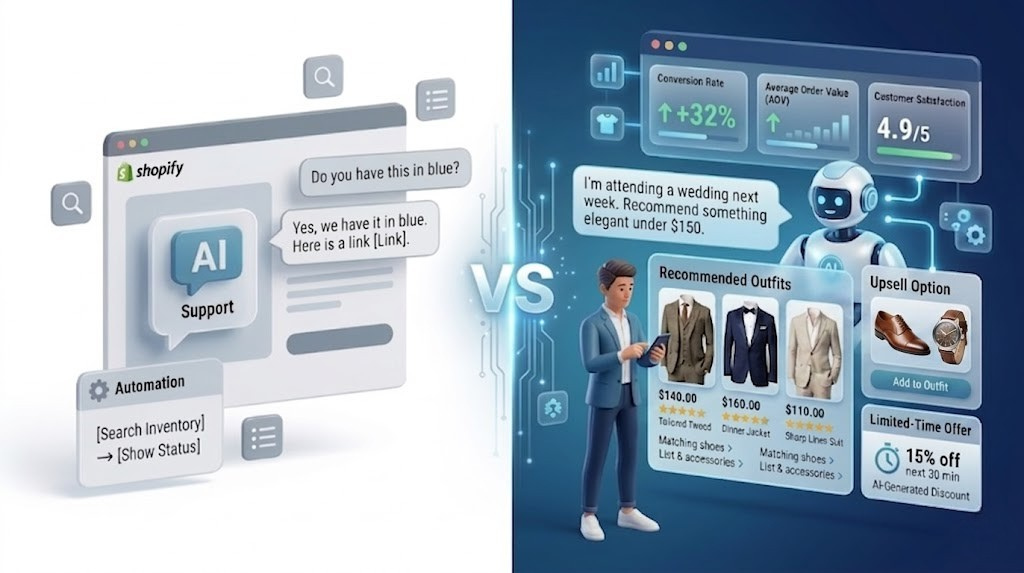
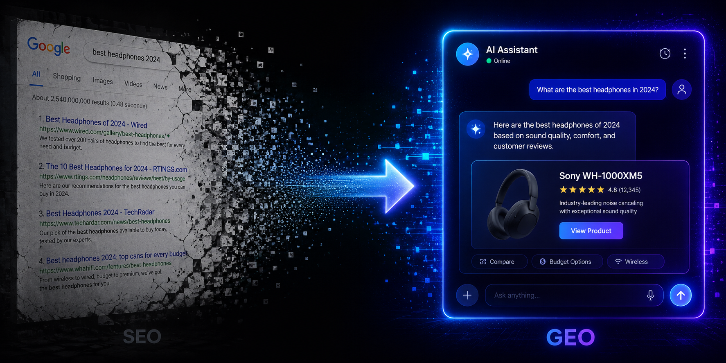
For twenty-five years, the rules of online visibility were simple: pick the right keywords, build backlinks, rank on page one of Google, and the traffic follows. That playbook built entire agencies, entire careers, and entire Shopify empires.
That playbook is now breaking in real time.
Search is no longer a list of ten blue links. It's a conversation. Shoppers are typing questions into ChatGPT, Gemini, Perplexity, and Google's AI Overviews instead of typing keywords into a search bar - and instead of getting a page of links to click through, they're getting a single, synthesized answer that tells them exactly what to buy. If your Shopify store isn't the brand that answer mentions, you don't just rank lower. You don't exist in that conversation at all.
This is the shift behind Generative Engine Optimization (GEO) - and for Shopify merchants in 2026, understanding it isn't optional homework anymore. It's survival.
What Is GEO, Actually? (Without the Jargon)
Generative Engine Optimization is the practice of structuring your brand, products, and content so that AI systems - ChatGPT, Google AI Mode, Gemini, Perplexity, and Shopify's own Sidekick - can find you, understand you, and recommend you inside a generated answer. Using tools like the ReComAI Shopify AI Agent can help ensure your store has the right structured data and product recommendations ready to be discovered.
Where traditional SEO optimizes for rankings, GEO optimizes for citations. The old goal was "rank #1 for this keyword." The new goal is "be the answer the AI gives when someone asks for the best product in this category."
It's also frequently called Answer Engine Optimization (AEO). The two terms are used almost interchangeably in the industry, though some practitioners draw a subtle line: AEO is about being the direct answer to a specific question, while GEO is the broader discipline of shaping how generative engines perceive your brand's authority. For a Shopify merchant, the practical difference barely matters - what matters is that both point toward the same shift: from ranking to being recommended. For a deeper look at agent architectures, read about AI agents vs AI workflows.
Why This Isn't Hype: The Numbers Behind the Shift
Skepticism is healthy, especially with a term this buzzy. But the data behind this shift is no longer speculative - it's showing up directly in merchant revenue reports.
Shopify's own Q1 2026 commerce data shows that AI-referred orders have grown nearly 13x year-over-year, and sessions referred from AI chatbots have grown more than 8x in the same period. That's not a marginal channel anymore - that's a new front door to your store.
The quality of that traffic is arguably more important than the volume. According to the same Shopify data, visitors arriving from AI platforms convert at nearly 50% higher rates than visitors from organic search, and orders placed through AI-powered discovery carry roughly 14% higher average order value. AI-referred shoppers aren't casually browsing - by the time an AI has recommended a specific product, that shopper has already been pre-qualified through a conversation. They arrive closer to a buying decision than almost any other traffic source.
Adobe's holiday 2025 analytics reported a 693% year-over-year jump in traffic from generative AI tools to retail sites, with that traffic converting roughly 31% higher and bouncing 27% less than other channels. Around three-quarters of consumers now say they use AI somewhere in their shopping journey, even if a smaller share currently trust it to complete a purchase autonomously.
Put simply: the audience is already there. The only open question is whether your store is visible to it.

How AI Search Actually Works (The Part Most Guides Skip)
To optimize for something, you need to understand its mechanics - and this is where most GEO advice stays frustratingly vague. Here's what's actually happening behind the scenes.
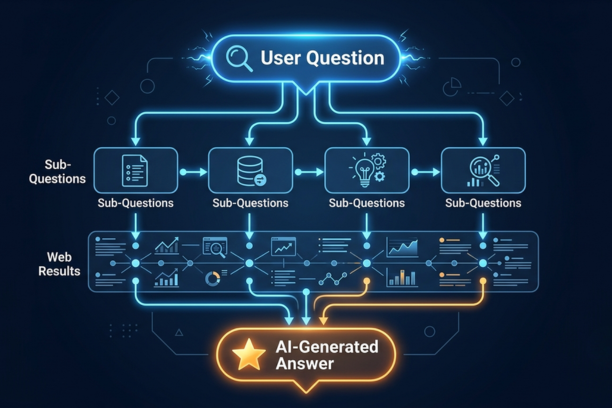
When a shopper asks an AI assistant something like "what are the best noise-cancelling headphones under $150," the engine doesn't just search that exact phrase. It performs what's known as query fan-out - breaking a single prompt into a cluster of related sub-questions (price comparisons, feature breakdowns, brand reputation, common complaints) and running each of those as a mini-search across the web. The results from all of those searches are then combined with the model's own training knowledge through a process called retrieval-augmented generation (RAG), and the AI synthesizes everything into one conversational answer.
This has a direct implication for your SEO and content strategy: if your product or blog content shows up in those underlying fan-out searches - even for a narrow subtopic - you dramatically increase your odds of being cited in the final AI answer. GEO doesn't replace the technical foundations of SEO; it depends on them. A page that isn't crawlable, indexable, and well-structured has almost no chance of being surfaced by an AI engine, because most of these tools still lean on traditional search indexes as a primary input.
The Uncomfortable Part: Zero-Click Search
The other mechanic worth understanding is what's called the "zero-click" problem. When an AI engine fully answers a shopper's question inside the chat interface itself, the shopper may never click through to any website at all. For publishers, this has been genuinely painful. For ecommerce, it's more nuanced - a shopper still has to land somewhere to complete a purchase, which means being the brand named in that answer still matters enormously, even if the click-through behavior looks different than it used to.
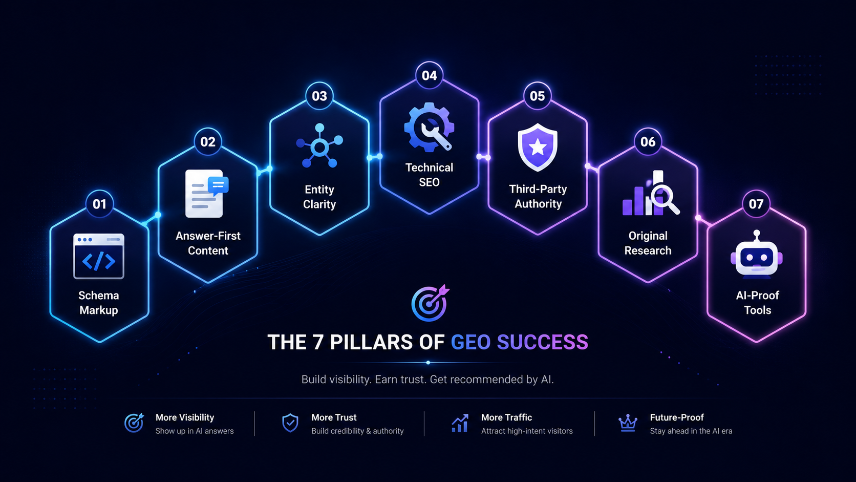
The Seven Pillars of GEO for a Shopify Store
Based on how leading Shopify merchants and agencies are approaching this in 2026, GEO implementation breaks down into seven practical layers. You don't need to tackle all seven simultaneously - but ignoring any one of them leaves a gap an AI engine will simply route around.
1. Structured Data and Schema Markup
AI engines don't "read" a page the way a human does - they parse it for entities and relationships. Product schema, Offer schema, FAQ schema, Review schema, and BreadcrumbList schema all give an AI system countable, extractable facts about what you sell, what it costs, whether it's in stock, and what real customers think of it. Stores that implement rigorous schema markup have reported meaningful lifts in both AI citation rates and click-through, simply because the structured data removes ambiguity for the crawler.
2. Answer-First Product and Content Pages
Product descriptions written purely for persuasion (adjectives, brand voice, vague benefit language) give an AI engine very little to extract. Product pages, buying guides, and FAQ content that directly answer specific buyer questions - "is this fabric machine washable," "what's the weight capacity," "how does this compare to [competitor]" - give generative engines exactly the kind of citable, factual material they're built to retrieve.
3. Entity Clarity and Brand Definition
AI models need to know unambiguously who you are. Consistent naming, a clear "About" page, consistent business information across your site, Google Business Profile, and third-party listings all help an AI model resolve your brand as a distinct, trustworthy entity rather than a vague or ambiguous match.
4. Technical Foundations
This is the unglamorous part that GEO still depends on entirely: fast load times, clean URL structures, mobile performance, HTTPS, and crawlability. None of this is new - it's classic technical SEO - but skipping it means an AI engine may never reach your structured data or your content in the first place.
5. Third-Party Authority and Consensus
Generative engines weigh consensus heavily - they're essentially looking for agreement across multiple independent sources before they'll confidently recommend a brand. That means reviews, user-generated content, creator mentions, and press coverage all function as trust signals feeding into whether an AI decides your brand is safe to cite. A single glowing product page written by you carries far less weight than dozens of independent voices saying similar things across the web.
6. Original Data and Research
Publishing genuinely original research, surveys, or proprietary data gives other sites and publications a reason to cite you - and citations from trusted publications are themselves a major input into whether AI answer engines trust your brand. This is one of the highest-leverage, lowest-competition moves available to smaller merchants right now, because very few are doing it.
7. Pre-Purchase Tools AI Can't Replicate
One counterintuitive but powerful GEO tactic: build interactive tools that a text-based AI answer simply cannot reproduce - a fit calculator, a color visualizer, a configurator. When an AI can't fully resolve a shopper's need inside the chat itself, it has a strong incentive to link out to the one tool that can. This turns a limitation of AI search into a source of qualified referral traffic.
GEO vs. Traditional SEO: A Side-by-Side View
| Traditional SEO | GEO / AEO | |
|---|---|---|
| Goal | Rank on page one | Be cited in the generated answer |
| Primary signal | Keywords, backlinks | Structured data, entity authority, consensus |
| Success metric | Search rankings, organic sessions | AI citation share, AI-referred conversions |
| Timeline | Typically 6 - 12 months to see results | Often 30 - 60 days, since AI tools re-crawl and re-evaluate more frequently |
| Content style | Optimized for scanning and ranking | Optimized for direct, extractable answers |
The key point that gets lost in "SEO is dead" headlines: GEO is not a replacement for SEO - it's built directly on top of it. A technically weak, poorly indexed site has no path into AI citations, no matter how well its content is written. SEO fundamentals are the floor. GEO is what you build on that floor to compete for the next decade of discovery.
Common Mistakes Shopify Merchants Are Making Right Now
Bulk AI-Generated Content Without Oversight
Using AI to mass-rewrite thousands of product descriptions without human review produces exactly the kind of generic, low-signal content that generative engines are trained to deprioritize. Volume without accuracy or specificity actively hurts your GEO performance.
Ignoring Buyer Intent
Grammatically polished content that never actually answers the shopper's real question - price, fit, comparison, use case - will not get cited, no matter how well-optimized the schema underneath it is. AI answer engines are, at their core, still trying to solve a person's problem.
Treating GEO as a One-Time Project
Because AI engines re-crawl and re-evaluate sources far more frequently than traditional search engines, GEO isn't a project you finish - it's an ongoing operational layer, closer to inventory management than to a one-off SEO audit.
Skipping the Technical Layer
No amount of well-written FAQ content will get surfaced if the underlying page is slow, poorly structured, or blocked from crawlers. Merchants chasing GEO content wins while ignoring Core Web Vitals are optimizing the wrong end of the funnel.
How to Measure Whether GEO Is Actually Working
Traditional rank tracking tells you almost nothing about AI visibility. Instead, track:
AI Citation Share - how often your brand or product is mentioned or linked as a source when you (or a tool) query ChatGPT, Perplexity, and Gemini for your target topics. AI-referred traffic and conversion - most modern analytics platforms can now segment sessions originating from AI referrers; watch this as its own channel rather than lumping it into "organic." Direct spot-checks - regularly ask the major AI tools the exact questions your customers would ask, and see whether your brand shows up, and how accurately it's described.
A Realistic Starting Framework
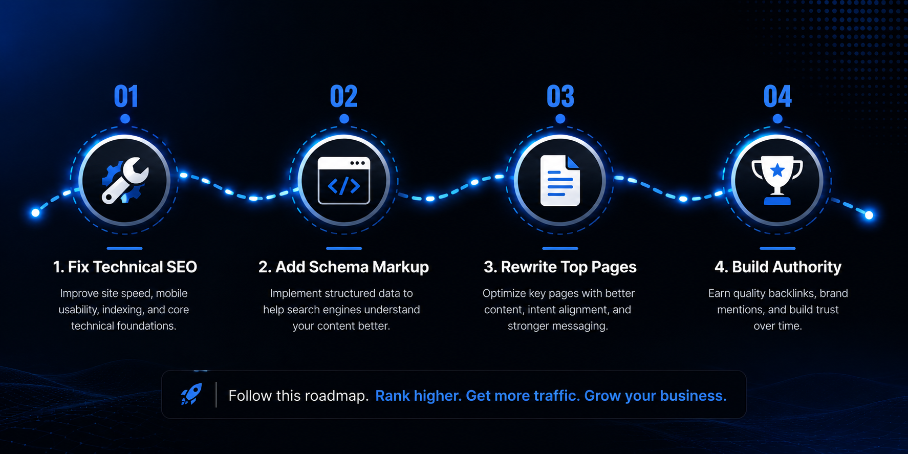
For a merchant starting from zero, the sequence that produces the fastest, most durable results looks like this: audit and fix your technical SEO foundation first, then implement Product, FAQ, and Review schema across your highest-traffic pages, then rewrite your top 20 product and category pages to directly answer the specific questions buyers are asking, and only then move into original research, PR, and off-site authority building. Skipping straight to content or PR without the technical and structured-data foundation underneath it is the single most common reason GEO efforts underperform.
Frequently Asked Questions (FAQs)
The traditional search funnel - type a keyword, scan ten blue links, click through - is quietly collapsing into a single conversational answer. For Shopify merchants, that's not a reason to panic. It's a rare moment where the playing field resets, and the brands that move first on structured data, answer-first content, and genuine authority will be the ones AI recommends for years to come.
Is your Shopify store ready for the AI search era, or still optimizing for a search results page that's slowly disappearing? Share your thoughts in the comments below.
Keywords