
Five years ago, most businesses automated repetitive work the same way: a trigger fired, a rule ran, and a predictable output came out the other side. An order came in, a workflow sent a confirmation email. A support ticket landed in a queue, a workflow routed it based on keywords. Nothing thought. Nothing decided. Something simply executed.
Today, that picture looks almost quaint. Software is planning multi-step tasks, choosing which tools to call, remembering what happened three conversations ago, and adjusting its approach mid-task when the first plan doesn't work. A shopper asks a chatbot for "something for dry, sensitive skin under 1,000 rupees that ships by Friday," and the system reasons through catalog data, stock levels, and shipping cutoffs before answering - no one wrote a rule for that exact question, because no one could have.
That shift has a name: Agentic AI, and it's arguably the defining enterprise technology story of 2026. Gartner expects 40% of enterprise applications to ship with task-specific AI agents by the end of this year, up from under 5% just twelve months ago - one of the fastest technology adoption curves ever recorded in enterprise software. McKinsey's 2026 Global AI Survey puts it differently but arrives at the same place: 88% of organizations now use AI somewhere in the business, and the number experimenting with agentic systems has crossed 60%.
But here's where most explanations go wrong. They jump straight to defining "AI Agent" as if it's a single, obvious category, and they treat "AI Workflow" as the outdated thing agents are replacing. That framing is misleading on both counts. Workflows aren't going away - they still power the majority of production automation running today, including inside many of the same companies rolling out agents. And plenty of things marketed as "AI Agents" are, on closer inspection, workflows wearing a chatbot interface.
The confusion is understandable. The terms get used interchangeably in vendor decks, LinkedIn posts, and product pages, often by people who benefit from the ambiguity. If you're a Shopify merchant deciding whether to automate your fulfillment emails or your customer support, a SaaS founder scoping your first AI feature, or a developer choosing between a rules engine and LangGraph, that ambiguity isn't harmless - it leads to overbuilt systems, underbuilt systems, and a lot of wasted engineering time.
This piece exists to remove that confusion. We'll define both terms precisely, show you real architecture diagrams for each, walk through when workflows are still the right call, when agents genuinely earn their complexity, and where the entire industry - from Anthropic to OpenAI to Google to NVIDIA - is placing its bets for what comes next.
1. What Is an AI Workflow?
An AI workflow is automation with a fixed shape. You define the steps in advance - sometimes with an AI model doing one or two of those steps - and the system executes them in that order, every time, regardless of what happens along the way.
The "AI" part usually sits inside one or two nodes of an otherwise deterministic pipeline. A workflow might use a language model to classify a support ticket, summarize a review, or draft an email - but the sequence of what happens before and after that AI step is fixed by a human designer, not decided by the system in the moment.
The building blocks
- Triggers. Something starts the workflow - a new order, a form submission, a scheduled time, a webhook from another system.
- Rule-based logic. If X, then Y. If the order value is over ₹5,000, apply free shipping. If a ticket contains the word "refund," route it to billing.
- Conditional branching. Slightly more sophisticated than a flat rule the workflow can split into different paths based on conditions, but every possible path was mapped out ahead of time by whoever built it.
- Deterministic execution. Given the same input, a workflow produces the same output path, every single time. That predictability is a feature, not a limitation.
Where you already see this
Tools like Zapier, Make, and n8n built entire businesses on this model - connect trigger A to action B, optionally branch on a condition, done. Shopify merchants use workflow automation constantly without necessarily calling it that: abandoned cart email sequences, inventory sync between systems, automatic tagging of high-value customers, discount codes that trigger on signup. Marketing automation platforms like Klaviyo or HubSpot run on the same logic - a lead scores above a threshold, a sequence fires.
Customer support routing is a classic example. A ticket comes in, keyword matching or a lightweight classifier determines it's a shipping question, and it's routed to the shipping queue. No reasoning happens about why the customer is asking or what would actually resolve their concern - the system just matches a pattern and moves the ticket along.
Benefits
Workflows are cheap to run, because a rule engine or a simple classifier costs a fraction of what a reasoning model call costs. They're predictable, which matters enormously in regulated industries or anywhere an unexpected output is unacceptable. They're easy to audit - you can trace exactly why a workflow did what it did, because the logic is explicit and static. And they're fast: no multi-step reasoning loop, no waiting on a model to "think."
Limitations
The moment a situation falls outside the paths someone anticipated, workflows break or produce the wrong output. They can't handle ambiguity - "my order is late and I'm also wondering if this cream will work for my toddler" doesn't fit cleanly into one branch. They don't learn from outcomes, and they don't remember context across sessions unless someone explicitly built that memory in. Scaling a workflow to cover more edge cases means adding more rules, and that complexity grows faster than the value it delivers - eventually you have a spaghetti diagram of conditions that nobody fully understands anymore.
2. What Is an AI Agent?
An AI agent is a system built around a language model that can reason about a goal, decide what to do next, use tools to act, observe the result, and adjust - repeatedly, without a human specifying each step in advance.
The difference from a workflow isn't the presence of AI. It's where the decision-making sits. In a workflow, a human decided the path in advance and the AI fills in a blank. In an agent, the model itself decides the path, in real time, based on the specific situation in front of it.
The core capabilities
- Reasoning. The model works through a problem in steps rather than pattern-matching to an immediate answer - breaking "find this customer a moisturizer under their budget that's in stock" into sub-questions about skin type, price ceiling, and inventory.
- Planning. Before acting, an agent can lay out a sequence of steps to reach a goal, and revise that plan if an early step doesn't go as expected.
- Memory. Short-term memory holds the current conversation's context. Longer-term memory - often backed by a vector database or a structured store - lets an agent recall a customer's past orders, preferences, or previous support history across sessions.
- Tool usage. This is what separates a chatbot from an agent. A tool might be a product search API, a payment processor, an order-tracking endpoint, or a code execution sandbox. The agent decides when to call a tool and what to pass it, based on reasoning about the task.
- Decision-making under ambiguity. Given an unclear or multi-part request, an agent doesn't need a pre-built branch for that exact combination - it works out an approach on the fly.
- Goal-oriented execution. An agent is typically given an objective rather than a script:"resolve this customer's issue," not "execute steps 1 through 7."
What this looks like in practice
A shopping assistant doesn't just search a catalog by keyword - it reasons across price, stock, variant availability, and the customer's stated preferences, then decides whether to recommend a product, ask a clarifying question, or check a policy first.
A coding agent doesn't just autocomplete a line - it reads a codebase, plans a multi-file change, runs tests, sees a failure, and revises its approach, sometimes across dozens of tool calls without a human in the loop.
A research agent breaks a broad question into sub-questions, searches multiple sources, cross-checks conflicting information, and synthesizes a structured answer - deciding what to search next based on what it's already found.
A customer support agent - the category most Shopify merchants will meet first - reads live order data, checks return policy, decides whether a refund is warranted, and processes it, escalating to a human only when the situation genuinely calls for judgment a policy doesn't cover.
Key takeaway
A workflow executes a predetermined path. An agent constructs the path itself, in the moment, based on reasoning about the specific situation.
3. Why Everyone Is Talking About Agentic AI
This isn't hype cycling on hype. Three things converged in 2025 and 2026 to make agentic AI viable at production scale, and every major lab has repositioned around it.
Reasoning models got good enough to trust with multi-step tasks. The jump from "answer this question" models to models that can hold a plan across a long task, self-correct, and call tools reliably closed the gap between demo and production. Anthropic, OpenAI, and Google DeepMind have all shipped dedicated agent SDKs and reasoning-tuned models built specifically for this - Anthropic's Claude Agent SDK added hierarchical sub-agent spawning in mid-2026, and OpenAI shipped its own Agents SDK the same year, signaling that both labs now treat "agent" as a first-class product category, not a wrapper around chat.
A standard for connecting models to the real world finally emerged. Anthropic introduced the Model Context Protocol (MCP) in late 2024 as an open way for AI models to connect to external tools and data - before MCP, every integration between a model and a database, CRM, or API was a custom, brittle, one-off build. By early 2026, MCP's SDKs were seeing roughly 97 million monthly downloads, OpenAI, Google DeepMind, and Microsoft had all adopted it, and Anthropic donated the protocol to the newly formed Agentic AI Foundation under the Linux Foundation - a deliberate move to make it vendor-neutral rather than something one company controls. That governance shift mattered commercially: enterprises are far more willing to build on a standard nobody can unilaterally change.
Microsoft, Google, and NVIDIA all rebuilt product lines around agents. Microsoft merged Semantic Kernel and AutoGen into a single Agent Framework in 2026, explicitly positioning it for enterprise deployment rather than research. Google shipped its own Agent Development Kit. NVIDIA used its 2026 GTC keynote to argue that agentic AI needs its own infrastructure stack entirely - reasoning-tuned Nemotron models, a runtime called OpenShell for governance and security beneath the agent layer, and partnerships with companies like Cadence, CrowdStrike, and Palantir already running agents in production. Jensen Huang's framing was blunt: agents will call more tools than any previous generation of software, and that changes what the infrastructure underneath needs to look like.
The business case stopped being theoretical. Salesforce publicly cut its customer support headcount from roughly 9,000 to 5,000 employees over 2025 as its Agentforce platform absorbed routine case volume, with AI agents now handling half of all customer interactions and support costs down 17%. McKinsey estimates AI agents could add $2.6 to $4.4 trillion in annual value across business functions. Those aren't projections from an AI vendor - they're documented, reported numbers from companies with earnings calls to answer to.
None of this means workflows are obsolete. It means a second layer of automation has become viable for problems workflows were never suited to solve - and every major platform is now building the plumbing to support it.
4. AI Workflow vs AI Agent: The Comparison
| Dimension | AI Workflow | AI Agent |
|---|---|---|
| Decision-making | Predetermined by the designer | Made by the model at runtime |
| Memory | None by default; must be built in explicitly | Native short- and long-term memory |
| Planning | Fixed sequence, set in advance | Dynamic; plans and revises in real time |
| Adaptability | Breaks or misfires outside defined paths | Handles novel or ambiguous situations |
| Tool use | Calls fixed, pre-wired integrations | Chooses which tools to call and when |
| Human input | Required upfront to map every path | Required for oversight, not every path |
| Flexibility | Low - new cases require new rules | High - reasons through new cases |
| Complexity | Low to moderate to build | Moderate to high to build and evaluate |
| Cost per task | Low (often no model call, or one small call) | Higher (multiple reasoning + tool-call steps) |
| Speed | Fast, near-instant | Slower - reasoning and tool calls take time |
| Reliability | Highly predictable and auditable | Probabilistic; needs evaluation and guardrails |
| Best use case | High-volume, structured, repetitive tasks | Ambiguous, multi-step, judgment-requiring tasks |
The pattern worth internalizing: workflows win on cost, speed, and predictability. Agents win on flexibility and handling the long tail of situations nobody thought to write a rule for. Most mature production systems in 2026 use both - a workflow for the 80% of cases that are routine, an agent for the 20% that need judgment.
5. How AI Agents Actually Work
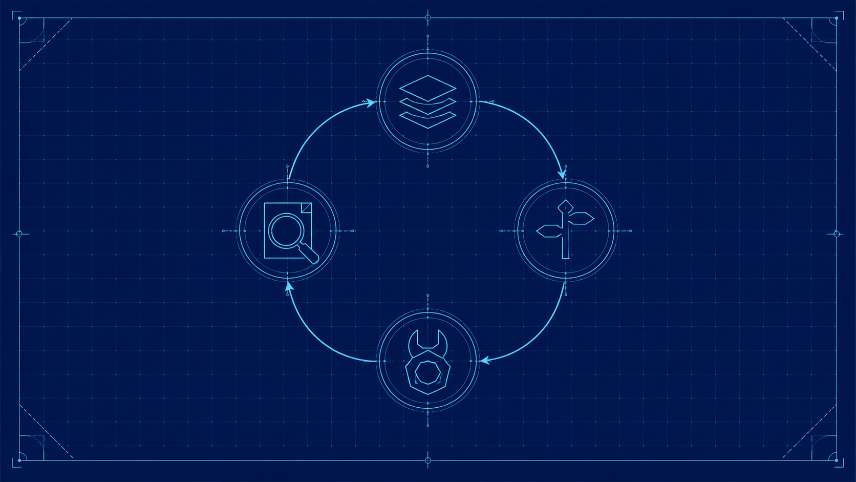
Strip away the marketing language and an agent is built from a small number of components working in a loop.
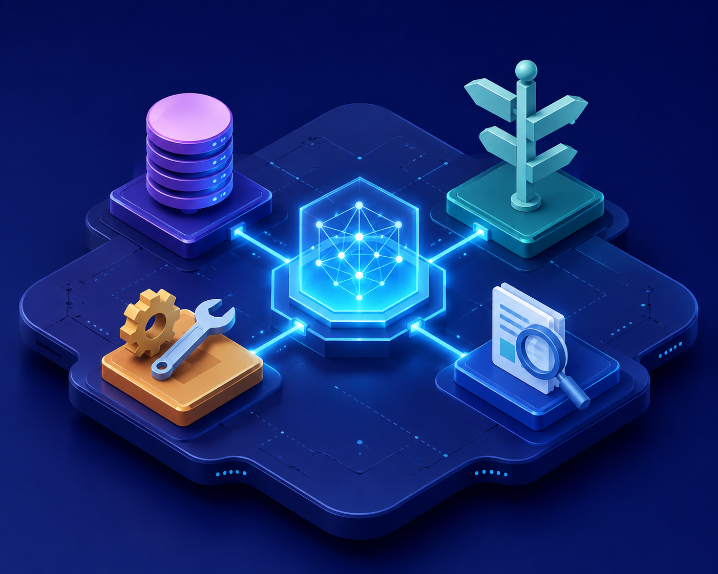
The language model is the reasoning core - it reads the current state of the task and decides what to do next, in plain language, at each step.
Memory comes in two flavors. Short-term memory is just the conversation so far, held in the model's context window. Long-term memory persists across sessions - a customer's past orders, a merchant's product catalog, a support policy document - usually stored in a database and retrieved when relevant, rather than stuffed into every prompt.
Planning is the model deciding, before or during execution, what sequence of actions will reach the goal. Some agent architectures make this explicit - write out a plan, then execute it step by step, checking in after each step - which tends to produce more reliable results on longer tasks than having the model improvise one step at a time.
Tool calling is how an agent acts on the world instead of just talking about it. The model is given a list of available tools - "search_products," "check_order_status," "issue_refund" - each with a description of what it does and what inputs it expects. When the model decides a tool is needed, it outputs a structured call to that tool; the surrounding system executes it and returns the result to the model, which then decides what to do next.
Retrieval is how an agent pulls in knowledge it wasn't trained on - a product catalog updated this morning, a company's specific return policy, a document a customer just uploaded. This is usually done through retrieval-augmented generation (RAG): relevant chunks of information are fetched based on the current query and added to the model's context before it responds.
The Model Context Protocol (MCP) solves a specific plumbing problem: without it, every tool an agent uses needs a custom integration built for that specific model provider. MCP standardizes this into a client-server relationship - a business builds one MCP server for its product catalog, and any MCP-compatible model (Claude, GPT, Gemini) can connect to it without a rebuild. Think of it as roughly analogous to how a USB port lets any compatible device plug into any compatible computer, rather than needing a proprietary cable for every combination.
Put together, the loop looks like this:
User request
     ↓
Agent reasons about the goal
     ↓
Agent plans next step
     ↓
Agent calls a tool (search, database, API) ──┐
     ↓                                       │
Tool returns a result ←──────────────────────┘
     ↓
Agent evaluates: is the goal met?
     ↓
   No → loop back to planning
   Yes → respond to the user
That loop - reason, act, observe, adjust - repeated until the goal is met or the agent decides to hand off to a human, is the entire mechanic underneath every "AI agent" product you've seen this year, whether it's answering a shipping question or opening a pull request.
6. Real Business Examples
- Ecommerce:Shopify's own Q1 2026 commerce data shows AI-referred shoppers - visitors arriving via ChatGPT, Perplexity, Gemini, or similar - converting at nearly 50% higher rates than organic search visitors, with 14% higher average order values. On the support side, agents handling order tracking, product recommendations, and returns are now standard on stores that have adopted them, resolving routine questions without a ticket ever reaching a human queue.
- Customer support (cross-industry):Salesforce's 2026 State of Service research, based on a survey of over 3,000 service professionals, found agentic AI adoption in customer service jumped from 39% to 66% in a single year. Industry-wide, median tier-one ticket deflection now sits around 41%, with refund and password-reset requests deflecting above 70%. Cost per AI-resolved interaction averages roughly $0.62 against $7.40 for a human-handled one - a gap large enough to change hiring plans, not just headcount at the margins.
- Healthcare:CVS Health has deployed agents that scan patient systems and prepare clinical briefings so nurses walk into each encounter already informed, rather than spending the first minutes of an appointment gathering context manually.
- Finance and operations:Agents are increasingly handling invoice matching, expense auditing, and anomaly detection in transaction data - tasks that are structured enough to automate but variable enough that rigid rules kept breaking.
- Software engineering:Coding agents that read a repository, plan a change across multiple files, run the test suite, and iterate on failures are now a normal part of engineering workflows at companies large and small - not a novelty demo.
- Marketing:PepsiCo uses an agent that predicts when a retail customer's inventory is likely running low based on past ordering patterns, and proactively sends a one-click resupply message - a task that requires reasoning about behavior patterns a static workflow couldn't anticipate case by case.

7. When Should You Use Workflows Instead?
Despite everything above, workflows remain the better choice for a large share of business automation - not the outdated choice, the correct one.
Use a workflow when the task is high-volume and structured. Sending an order confirmation email doesn't need reasoning. It needs to happen the same way, every time, for every order, cheaply and instantly.
Use a workflow when predictability is non-negotiable. If a wrong output is unacceptable - calculating tax, applying a discount code, triggering a compliance alert - a deterministic system you can fully audit beats a probabilistic one, even a very good one.
Use a workflow when the cost of an agent isn't justified. Running a full reasoning loop with tool calls to decide whether to send a "your package shipped" notification is like hiring a consultant to answer a yes/no question. The workflow does it for a fraction of the cost and in a fraction of the time.
Use a workflow when the logic genuinely doesn't branch much. If a task has two or three well-understood paths and rarely encounters an edge case outside them, the flexibility an agent offers isn't buying you anything - you're paying agent-level cost and latency for workflow-level output.
Practical Shopify examples: inventory sync between systems, abandoned cart email sequences, order status webhooks to a fulfillment partner, automatic customer tagging based on purchase history. None of that benefits from a model reasoning about it - it benefits from running fast, cheap, and exactly the same way every time.
8. When AI Agents Make More Sense
Flip the criteria and the case for an agent becomes just as clear.
The task involves genuine ambiguity. "Can I use niacinamide if I'm also using retinol?" isn't a lookup - it requires synthesizing product information, general skincare knowledge, and the specific products in a catalog. A workflow can't branch cleanly for a question shaped like that; an agent reasons through it.
The task spans multiple steps that depend on each other's outcomes. Resolving "my order arrived damaged and I need a replacement, but I also want to change the shipping address" requires checking order status, verifying the damage claim policy, updating an address, and creating a new fulfillment - each step informed by what the previous one returned. That's a plan-and-adjust problem, not a single rule.
The value of getting it right exceeds the cost of reasoning. A support interaction that would otherwise churn a customer, or a sales conversation that closes a high-value order, easily justifies the marginal cost of an agent's tool calls and reasoning steps.
The inputs are too varied to enumerate in advance. Free-text customer questions, unpredictable product catalogs, or conversations that shift topic mid-stream are exactly the long-tail scenarios workflows can't cover without an unmanageable number of rules.
A useful mental shortcut: if you can draw the entire decision tree on a whiteboard and feel confident it covers every real case, build a workflow. If you keep discovering new branches every time you look at real conversation logs, that's a strong signal you need an agent.
9. The Biggest Misconceptions
"AI Agents replace employees." Partially true in narrow, high-volume categories - Salesforce's own headcount reduction in routine support roles is real and documented. But the same data shows agents are most effective alongside people, handling volume so humans handle judgment calls, escalations, and relationship-building. The pattern across every mature deployment is augmentation of complex work, not wholesale replacement of a function.
"AI Agents think like humans." No. An agent reasons through steps in a way that resembles human problem-solving on the surface, but it has no persistent understanding, no genuine goals of its own, and no experience outside what's in its context and training. It's pattern-based reasoning at a very high level of sophistication - not cognition.
"Every chatbot is an AI Agent." False, and this is the most common marketing conflation of 2026. A chatbot that answers FAQs from a fixed script, or even one powered by a language model that only ever responds without calling tools or maintaining a plan across steps, is not an agent - it's a conversational interface. The defining feature of an agent is autonomous, multi-step tool use in service of a goal, not the presence of natural language.
"Workflows are outdated." Also false. Workflows remain the backbone of most production automation, including inside companies that have deployed agents extensively. The mature answer for most businesses in 2026 isn't "replace your workflows with agents" - it's "keep your workflows for what they're good at, and add agents for what they aren't."
10. Challenges of AI Agents
None of this comes free, and any honest treatment of agentic AI has to sit with the real operational costs.
- Hallucinations:An agent that confidently reasons its way to a wrong conclusion - misreading stock levels, misapplying a policy - is a harder failure mode to catch than a workflow's clean, binary errors, because the output often looks correct.
- Latency:A multi-step reasoning loop with several tool calls takes meaningfully longer than a single rule evaluation. For time-sensitive interactions, that gap is noticeable.
- Cost:Every reasoning step and tool call is a model inference. At scale, a poorly scoped agent running unnecessary loops can get expensive fast compared to the workflow it might have replaced.
- Memory management:Deciding what to remember, for how long, and how to retrieve it accurately - without leaking one customer's data into another's context - is a genuinely hard engineering problem, not an afterthought.
- Privacy and security:An agent with tool access to order systems, payment data, or customer records is a larger attack surface than a static workflow. A 2026 security audit found roughly 200,000 exposed MCP servers vulnerable to remote code execution through a default transport setting - a reminder that the tooling connecting agents to the real world needs the same security discipline as any other production infrastructure.
- Evaluation:Testing a workflow is straightforward: check the output against the expected output for a given input. Testing an agent means evaluating a process, not just an outcome, across a huge range of possible situations, and doing that rigorously is still an underdeveloped discipline across the industry.
- Governance:McKinsey's 2026 AI Trust Maturity Survey found only about a third of organizations report mature governance controls for agentic systems, and 45% of executives cite a lack of visibility into how their agents make decisions as a significant barrier. Gartner, meanwhile, expects more than 40% of agentic AI projects to be cancelled by the end of 2027 - largely from unclear ROI and weak risk controls, not from the technology failing outright.
That last statistic is worth sitting with. The failure mode isn't usually "the agent didn't work." It's "we built an agent for a problem a workflow would have solved better, at a fraction of the cost and risk."
11. The Future of Agentic AI
- Personal AI assistants that manage tasks across a person's entire digital life - not just one app - are moving from research demo to shipping product, with agent-to-agent communication protocols emerging alongside MCP to let different companies' agents coordinate.
- Autonomous shopping is already measurable, not theoretical:Shopify's Winter 2026 "Agentic Storefronts" feature lets merchants syndicate one product catalog to ChatGPT, Perplexity, and Microsoft Copilot at once, and early data shows those AI-referred shoppers converting meaningfully better than traditional search traffic.
- Business copilots - agents embedded directly in the tools employees already use, rather than a separate chat window - are becoming the default interface for internal software, following the pattern Microsoft, Salesforce, and Google are each building toward.
- AI operating systems is the more speculative but increasingly discussed idea:an orchestration layer that manages many specialized agents the way a traditional OS manages processes, allocating resources, handling permissions, and coordinating handoffs between agents built by different teams or vendors.
- Multi-agent collaboration is already standard in production for complex tasks - one agent researching, another verifying, another executing - coordinated through frameworks like LangGraph or Microsoft's unified Agent Framework, with MCP and emerging agent-to-agent protocols letting agents built on entirely different stacks talk to each other.
The common thread across all five: 2026 is the year agentic AI stopped being a single chatbot answering a single question, and started becoming infrastructure - a layer other software is built on top of, the way APIs became infrastructure a decade earlier. Businesses like ReComAI, which builds Shopify AI Agents, are one small example of that broader shift: a purpose-built agent handling product discovery and order support so a store's live catalog and order data can answer customers directly, instead of routing every question through a static help page.

12. Final Thoughts
The workflow-versus-agent question isn't really a competition. It's a matching problem. Workflows are the right tool when a task is structured, high-volume, and doesn't benefit from reasoning - building an agent for that is over-engineering. Agents are the right tool when a task is ambiguous, multi-step, and genuinely requires judgment - forcing that into a workflow means an ever-growing pile of brittle rules chasing edge cases they'll never fully cover.
What's changed in 2026 isn't that agents made workflows obsolete. It's that, for the first time, businesses actually have a real second option for the category of problems workflows were never built to solve - and the infrastructure to build that option reliably, from reasoning models to the Model Context Protocol to production-grade orchestration frameworks, finally exists at a maturity level businesses can build on with confidence. If you want to connect your customer support channels directly, you can explore specialized channels like the WhatsApp AI Sales Agent, Instagram AI Sales Agent, or Messenger AI Sales Agent.
The organizations getting real value in 2026 aren't the ones that picked a side. They're the ones that got specific about which of their problems are which - and built accordingly.
Frequently Asked Questions
Q: What is the main difference between an AI workflow and an AI agent?
A: An AI workflow follows a fixed sequence of steps defined in advance by a human, with AI sometimes handling one step inside that sequence - like classifying a message or drafting text. An AI agent, by contrast, decides its own sequence of steps at runtime, based on reasoning about the specific situation. The workflow's logic lives in a diagram someone built beforehand; the agent's logic lives in the model's reasoning process as it works through the task. This is why workflows are predictable and cheap, while agents are flexible but more variable in cost, speed, and output.
Q: Are AI agents just chatbots with extra steps?
A: No, and this is one of the most common misunderstandings in 2026. A chatbot, even one powered by a sophisticated language model, becomes an agent only when it can autonomously decide to use tools, form a multi-step plan, and adjust that plan based on results - not just respond conversationally. A chatbot that answers questions from a fixed script or single-turn model response, without acting on external systems or planning ahead, is not an agent by the technical definition, even if it feels conversational.
Q: Do AI agents replace AI workflows?
A: Not in most production systems. The two are typically complementary: workflows handle the high-volume, structured, predictable portion of a business process, while an agent is layered in for the ambiguous or judgment-heavy cases that fall outside what a workflow can reliably branch for. Most companies with mature automation in 2026 run both side by side rather than replacing one with the other entirely.
Q: Why is Agentic AI growing so fast in 2026?
A: Three factors converged: reasoning models became reliable enough for multi-step tasks, the Model Context Protocol gave agents a standard way to connect to external tools and data without custom integrations for every combination, and major platforms - Anthropic, OpenAI, Google, Microsoft, Salesforce, and NVIDIA among them - rebuilt significant parts of their product roadmaps around agents. Combined with documented business results, like Salesforce's reported support-cost reductions from Agentforce, the shift moved from experimental to operational within about eighteen months.
Q: What is the Model Context Protocol (MCP), and why does it matter?
A: MCP is an open standard, originally released by Anthropic in late 2024, that lets AI models connect to external tools, databases, and services through a single, consistent interface rather than a custom integration for every model-and-tool combination. It has since been adopted by OpenAI, Google DeepMind, and Microsoft, and was donated to a vendor-neutral foundation under the Linux Foundation in December 2025. For businesses, it matters because it lowers the cost of connecting an agent to real data - a product catalog, an order system, a support policy - without locking that integration to one specific AI provider.